
Figuring out how much material you need in cubic yards is crucial for many projects, from building a patio to filling a garden bed. How much material you need can be figured out by multiplying the length, width, and height of the area you want to fill, then dividing by 27. This guide will walk you through the simple steps to accurately calculate cubic yards for your construction and landscaping needs.
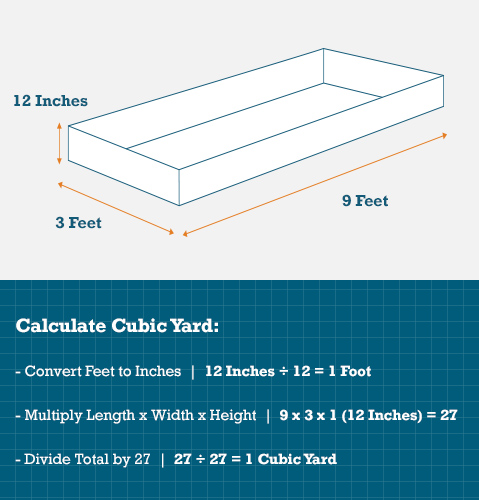
Image Source: www.budgetdumpster.com
Why Measuring in Cubic Yards Matters
When you’re planning any kind of project that involves bulk materials like soil, gravel, sand, or concrete, you’ll almost always see prices quoted in cubic yards. This is the standard unit of measurement for these items. Whether you’re a homeowner tackling a DIY garden makeover or a contractor managing a large construction site, getting your volume calculation right is key to avoiding overspending or, worse, running out of essential landscaping materials mid-job.
Think about it: if you need to build a retaining wall, pour a small concrete foundation for a shed, or simply bring in enough topsoil to level your backyard, ordering the correct amount of material saves you time, money, and frustration. Too little, and you’re making extra trips to the store or waiting for another delivery. Too much, and you have excess aggregate volume or soil volume cluttering up your workspace, potentially costing you extra disposal fees.
The Basic Formula: Length x Width x Height
The foundation of figuring out cubic yards lies in a simple geometric principle: volume. For a rectangular or square area, which is the most common shape you’ll encounter, the formula for volume is:
Volume = Length × Width × Height
However, there’s a catch. This formula gives you the volume in cubic feet if you measure your length, width, and height in feet. Since materials are sold in cubic yards, you need to convert this measurement.
Step 1: Measure Your Area in Feet
The first and most important step is accurate measurement. Grab your tape measure and head to your project site. Measure the dimensions of the area you need to fill or cover.
- Length: Measure the longest side of the area.
- Width: Measure the shorter side of the area.
- Height (or Depth): This is how deep you want the material to be. For example, if you’re adding mulch to a garden bed, this would be the depth of the mulch. If you’re pouring concrete for a patio, this is the thickness of the slab.
Make sure you measure in feet for all three dimensions. If you have measurements in inches, convert them to feet before you proceed. To convert inches to feet, divide the number of inches by 12 (since there are 12 inches in a foot).
Converting Inches to Feet: A Quick Guide
- 6 inches = 0.5 feet
- 9 inches = 0.75 feet
- 12 inches = 1 foot
- 18 inches = 1.5 feet
- 24 inches = 2 feet
Example 1: A Rectangular Garden Bed
Let’s say you have a garden bed that needs new topsoil. You measure it and find:
- Length: 10 feet
- Width: 5 feet
- Desired Depth: 6 inches (which is 0.5 feet)
Step 2: Calculate the Volume in Cubic Feet
Now, plug your measurements into the volume formula:
Volume (in cubic feet) = Length × Width × Height (or Depth)
Using our garden bed example:
Volume = 10 feet × 5 feet × 0.5 feet
Volume = 250 cubic feet
Step 3: Convert Cubic Feet to Cubic Yards
This is where the conversion happens. There are 3 feet in 1 yard. Therefore, there are 3 feet × 3 feet × 3 feet = 27 cubic feet in 1 cubic yard.
To convert your cubic feet measurement to cubic yards, divide the total cubic feet by 27.
Cubic Yards = Cubic Feet / 27
Continuing with our garden bed example:
Cubic Yards = 250 cubic feet / 27
Cubic Yards ≈ 9.26 cubic yards
So, you would need approximately 9.26 cubic yards of topsoil for your garden bed. It’s often wise to round up slightly to account for settling or any minor measurement inaccuracies. For this project, ordering 9.5 or even 10 cubic yards would be a safe bet.
Figuring Cubic Yards for Different Shapes
While rectangular and square areas are common, you might encounter other shapes in your projects. Here’s how to handle them:
Circular Areas
For circular areas, like a tree ring or a round patio base, you’ll need the radius of the circle. The radius is half the diameter. The formula for the area of a circle is:
Area of Circle = π × radius² (where π is approximately 3.14159)
Once you have the area of the circle in square feet, you can calculate the volume in cubic yards using the same depth measurement as before.
Volume (in cubic feet) = Area of Circle × Depth
Then, convert to cubic yards:
Cubic Yards = Volume (in cubic feet) / 27
Example 2: A Circular Tree Ring
Suppose you want to put mulch around a tree. The tree has a diameter of 6 feet. This means the radius is 3 feet (6 feet / 2). You want the mulch to be 4 inches deep (0.33 feet).
-
Calculate the Area of the Circle:
Area = π × radius²
Area = 3.14159 × (3 feet)²
Area = 3.14159 × 9 square feet
Area ≈ 28.27 square feet -
Calculate the Volume in Cubic Feet:
Volume = Area × Depth
Volume = 28.27 square feet × 0.33 feet
Volume ≈ 9.33 cubic feet -
Convert to Cubic Yards:
Cubic Yards = Volume / 27
Cubic Yards = 9.33 cubic feet / 27
Cubic Yards ≈ 0.35 cubic yards
So, you’ll need about 0.35 cubic yards of mulch. This is a good example where you might buy mulch by the bag rather than by the cubic yard, as it’s a small quantity.
Rectangular Areas with Varying Depth
Sometimes, your depth might not be perfectly uniform, especially in landscaping. If you have a slope, the best approach is to take several depth measurements across the area and calculate an average depth.
Average Depth = (Sum of all depth measurements) / (Number of measurements)
Then, use this average depth in your volume calculation:
Volume (in cubic feet) = Length × Width × Average Depth
And finally, convert to cubic yards:
Cubic Yards = Volume (in cubic feet) / 27
Irregular Shapes
For truly irregular shapes, like a winding flower bed, it’s often easiest to break the shape down into smaller, manageable geometric shapes (rectangles, squares, triangles, semi-circles) and calculate the volume for each section separately. Then, add all the individual cubic yardage calculations together.
Alternatively, you can estimate the area by using a grid method or by approximating the shape with a rectangle and adjusting for the differences. For critical construction volume projects, precise measurements are vital, and you might consider using specialized software or consulting with a professional surveyor. For many landscaping jobs, a good approximation is usually sufficient.
Common Project Examples and Their Calculations
Let’s look at some common projects and how measuring materials in cubic yards applies:
Example 3: Concrete Volume for a Patio Slab
You want to pour a concrete patio slab that is 12 feet long, 10 feet wide, and 4 inches thick.
- Length = 12 feet
- Width = 10 feet
- Depth = 4 inches = 4/12 feet = 0.33 feet
-
Cubic Feet:
Volume = 12 ft × 10 ft × 0.33 ft = 39.6 cubic feet -
Cubic Yards:
Cubic Yards = 39.6 cubic feet / 27 ≈ 1.47 cubic yards
For concrete, it’s common practice to round up significantly and add a buffer (often 10%) for overages, uneven subgrades, and spills. So, for this patio, you’d likely order 1.75 to 2 cubic yards of concrete. This is a prime example where an accurate concrete volume calculation is essential to avoid costly mistakes.
Example 4: Gravel for a Driveway Base
You need to add a 3-inch layer of gravel to a driveway that is 50 feet long and 10 feet wide.
- Length = 50 feet
- Width = 10 feet
- Depth = 3 inches = 3/12 feet = 0.25 feet
-
Cubic Feet:
Volume = 50 ft × 10 ft × 0.25 ft = 125 cubic feet -
Cubic Yards:
Cubic Yards = 125 cubic feet / 27 ≈ 4.63 cubic yards
For gravel and other aggregates, ordering slightly more than calculated is also recommended, as they can compact. Aiming for around 5 cubic yards would be a good choice for this driveway. This demonstrates a typical aggregate volume requirement.
Example 5: Soil Volume for a Raised Garden Bed
You’re building a raised garden bed that is 8 feet long, 4 feet wide, and 1.5 feet deep.
- Length = 8 feet
- Width = 4 feet
- Depth = 1.5 feet
-
Cubic Feet:
Volume = 8 ft × 4 ft × 1.5 ft = 48 cubic feet -
Cubic Yards:
Cubic Yards = 48 cubic feet / 27 ≈ 1.78 cubic yards
This calculation is for your soil volume needs. You might round up to 2 cubic yards to be safe. This is a common dirt calculation scenario for gardeners.
Using a Cubic Yard Calculator
Manually calculating cubic yards is straightforward, but for complex shapes or if you want to double-check your work, online cubic yardage calculator tools are incredibly helpful. These calculators are designed to simplify the process. You typically input your measurements (length, width, depth) and the calculator automatically performs the volume calculation and conversion to cubic yards.
Many construction supply companies, landscaping services, and DIY websites offer free cubic yardage calculators. They are a great resource for quick estimates and to ensure accuracy, especially for larger projects or when dealing with different units of measurement.
Factors to Consider Beyond Basic Calculation
While the formula is simple, a few real-world factors can influence the actual amount of material you need:
- Compaction: Many materials, especially soil, gravel, and mulch, will compact over time or when they are tamped down. This means they will settle and take up less space. It’s generally wise to order about 10% more than your calculation to account for compaction.
- Settling: Similar to compaction, newly placed materials might settle due to moisture, vibration, or natural settling.
- Uneven Subgrade: The ground beneath your material might not be perfectly level. Low spots will require more material to fill, while high spots might use less. Taking an average depth helps, but significant unevenness might require ordering a little extra.
- Waste and Spillage: During loading, transport, and spreading, some material can be lost due to spillage or accidental waste. Having a small buffer accounts for this.
- Product Form: Some materials are sold in different forms. For instance, soil might be loose or in compacted bags. Ensure you understand how the supplier measures their bulk materials.
Frequently Asked Questions (FAQ)
Q1: What is a cubic yard?
A cubic yard is a unit of volume in the imperial and US customary systems. It represents the volume of a cube that is one yard long, one yard wide, and one yard high. Equivalently, it is 27 cubic feet or approximately 0.765 cubic meters.
Q2: Can I use a calculator for all my projects?
Yes, a cubic yardage calculator is a handy tool for most projects, especially those involving regular shapes. For very complex or irregular areas, you might need to break them down into simpler shapes first before using the calculator.
Q3: How do I convert inches to feet for my measurements?
To convert inches to feet, divide the number of inches by 12. For example, 6 inches divided by 12 equals 0.5 feet.
Q4: What if my area isn’t a perfect rectangle or circle?
For irregular shapes, the best approach is to divide the area into smaller, regular shapes (rectangles, squares, triangles, semi-circles). Calculate the cubic yards for each section and then add them together. Alternatively, you can approximate the area with a larger regular shape and then make adjustments.
Q5: Do I need to order more than the calculated amount?
Yes, it is generally recommended to order about 10% more material than your exact calculation to account for compaction, settling, waste, and minor inaccuracies in measurement.
Q6: How do I calculate the volume for a sloped area?
For a sloped area, take several depth measurements across the area and calculate an average depth. Use this average depth in your volume calculation.
Q7: What is the difference between cubic feet and cubic yards?
A cubic yard is much larger than a cubic foot. There are exactly 27 cubic feet in one cubic yard (3ft x 3ft x 3ft = 27 cu ft).
Q8: Is there a difference in how I calculate for soil versus gravel?
The basic volume calculation method is the same for soil, gravel, sand, mulch, and concrete. The primary difference in practice is the consideration for compaction, which is often more significant with granular materials like gravel and soil.
Q9: How thick should my concrete slab be?
For most residential applications like patios or walkways, a concrete slab thickness of 4 inches is standard. For driveways or areas that will bear heavier loads, 5-6 inches might be necessary. Always check local building codes or consult with a professional for specific project requirements.
Q10: Where can I find a cubic yardage calculator online?
You can find many free cubic yardage calculators by searching online. Popular sources include websites of landscaping companies, construction material suppliers, and DIY home improvement sites.
By following these steps and keeping the conversion factor of 27 cubic feet per cubic yard in mind, you can accurately determine the amount of material needed for any project. This skill is invaluable for efficient planning and successful execution, whether you’re working with landscaping materials, construction volume requirements, or simply needing to do a basic dirt calculation.