
A typical wheelbarrow holds about 2 to 6 cubic feet of material. This is a common question for anyone tackling a landscaping project, moving garden soil, or clearing out yard debris. Knowing this conversion is key to estimating how much material you’ll need and how many trips you’ll make.
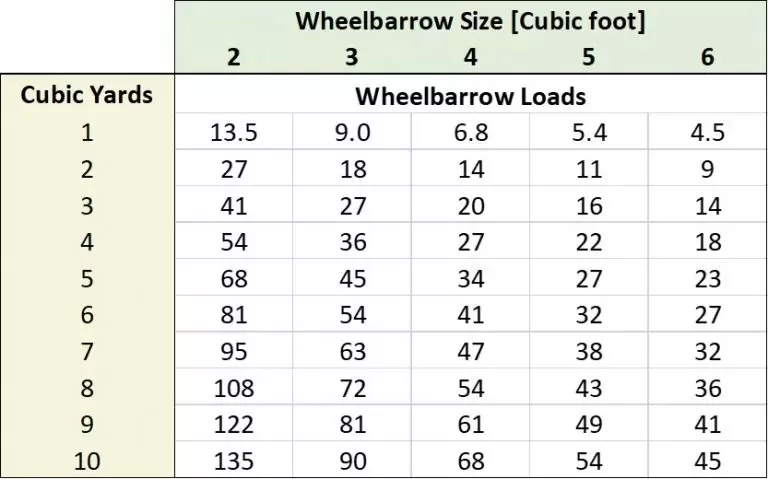
Image Source: www.appletreenursery.net
Deciphering Wheelbarrow Capacity
When you’re out in the yard, whether you’re moving soil, mulch, or gravel, the humble wheelbarrow is your trusty companion. But how much does it actually hold? The answer isn’t a simple number because wheelbarrow capacities vary. Let’s dive into what makes up a wheelbarrow’s capacity and how to measure it.
Standard Wheelbarrow Sizes
Wheelbarrows come in different sizes, and their capacity is usually measured in cubic feet. Here’s a general idea:
- Small Homeowner Wheelbarrows: These often hold around 2 to 3 cubic feet. They are great for light gardening tasks.
- Medium Homeowner Wheelbarrows: You’ll find these with capacities of 3 to 4 cubic feet. They offer a good balance for most home projects.
- Heavy-Duty/Contractor Wheelbarrows: These can hold 5 to 6 cubic feet or even more. They are built for tougher jobs and larger volumes.
Important Note: The stated capacity is usually for the level fill of the basin. When you’re piling material high, you can often fit more. However, for accurate calculations, it’s best to start with the manufacturer’s listed capacity or measure it yourself.
Factors Affecting Wheelbarrow Loads
Several things influence how much you can fit into your wheelbarrow:
- Material Type: Lightweight materials like mulch or straw will pile higher than dense materials like wet soil or gravel. This means you can fit more volume of lighter stuff.
- How You Load It: Are you just scooping and dumping, or are you carefully packing the material? A well-packed load might hold more, but it’s harder to estimate consistently.
- The Shape of the Wheelbarrow: Most wheelbarrows have a roughly rectangular or trapezoidal basin. The exact dimensions can slightly alter the true volume.
- Overfilling: While you might get more in, overfilling makes the wheelbarrow unstable and difficult to push, leading to spills and safety issues.
Converting Wheelbarrows to Cubic Yards
Now, let’s talk about the big picture: cubic yards. This is the standard unit for ordering bulk materials like topsoil, gravel, or large quantities of mulch. If you need to order 5 cubic yards of topsoil, how many wheelbarrow trips will that take? This is where the wheelbarrow to cubic yard conversion comes into play.
The Math Behind the Conversion
First, we need to know the conversion factor:
- 1 cubic yard = 27 cubic feet
This means one cubic yard is a significantly larger volume than a single wheelbarrow trip.
Calculating Loads: From Cubic Feet to Cubic Yards
To convert your wheelbarrow’s capacity from cubic feet to cubic yards, you divide the cubic feet by 27.
Formula:
- Wheelbarrow Capacity (Cubic Yards) = Wheelbarrow Capacity (Cubic Feet) / 27
Let’s look at some examples using common wheelbarrow capacities:
| Wheelbarrow Capacity (Cubic Feet) | Calculation (Cubic Feet / 27) | Wheelbarrow Capacity (Cubic Yards) |
|---|---|---|
| 2 cubic feet | 2 / 27 | Approximately 0.074 cubic yards |
| 3 cubic feet | 3 / 27 | Approximately 0.111 cubic yards |
| 4 cubic feet | 4 / 27 | Approximately 0.148 cubic yards |
| 5 cubic feet | 5 / 27 | Approximately 0.185 cubic yards |
| 6 cubic feet | 6 / 27 | Approximately 0.222 cubic yards |
As you can see, even a large wheelbarrow holds a small fraction of a cubic yard.
Estimating Wheelbarrow Loads for Different Materials
The type of material you’re moving significantly impacts how much weight and volume you can comfortably handle in a wheelbarrow. This is crucial for estimating wheelbarrow loads and calculating yard material.
Mulch Per Wheelbarrow
Mulch is generally lightweight and fluffy. This means you can often pile it high without exceeding the weight limit of your wheelbarrow.
- Typical Mulch Load: A common homeowner wheelbarrow (around 3-4 cubic feet) can often carry 4 to 5 cubic feet of piled mulch.
- Calculating Trips for Mulch: If you need 3 cubic yards of mulch and your wheelbarrow holds about 4.5 cubic feet (which is 4.5 / 27 = 0.167 cubic yards per load), you would need approximately:
- 3 cubic yards / 0.167 cubic yards per wheelbarrow = 18 wheelbarrow loads.
Soil Per Wheelbarrow
Soil, especially when moist, is much denser than mulch. Overfilling a wheelbarrow with soil can make it extremely heavy and hard to manage.
- Typical Soil Load: For a 3-4 cubic foot wheelbarrow, a safe and manageable load of soil is closer to 2.5 to 3.5 cubic feet.
- Calculating Trips for Soil: If you need 2 cubic yards of topsoil and your wheelbarrow can handle 3 cubic feet (which is 3 / 27 = 0.111 cubic yards per load), you’d need:
- 2 cubic yards / 0.111 cubic yards per wheelbarrow = 18 wheelbarrow loads.
Gravel Per Wheelbarrow
Gravel is one of the heaviest materials. Gravel per wheelbarrow loads will be the smallest in terms of volume compared to mulch or soil, due to its weight.
- Typical Gravel Load: A 3-4 cubic foot wheelbarrow might only handle 1.5 to 2.5 cubic feet of gravel before becoming too heavy.
- Calculating Trips for Gravel: If you need 1 cubic yard of gravel and your wheelbarrow can carry 2 cubic feet (which is 2 / 27 = 0.074 cubic yards per load), you would need:
- 1 cubic yard / 0.074 cubic yards per wheelbarrow = 13.5 wheelbarrow loads (round up to 14).
Yard Debris Volume
When clearing yard debris volume, such as leaves, branches, or grass clippings, the volume can vary wildly. Dry leaves are very light and fluffy, while wet grass clippings can be heavy and compact.
- Estimating Yard Debris: It’s best to measure the actual volume you’re accumulating in your wheelbarrow. A common homeowner wheelbarrow might hold 3 to 5 cubic feet of mixed yard debris.
- Calculating Disposal: If you’re filling the wheelbarrow with debris and taking it to a green waste facility that charges by volume, you’ll use the cubic feet measurement. If you need to convert it to cubic yards for a disposal bin, remember to divide by 27. For instance, 10 wheelbarrow loads of debris, each averaging 4 cubic feet (40 cubic feet total), would be 40 / 27 = 1.48 cubic yards.
Practical Tips for Calculating Yard Material
Accurately calculating yard material and managing your wheelbarrow trips can save you time and effort. Here are some practical tips:
Measuring Your Wheelbarrow
If you don’t know your wheelbarrow’s capacity, you can measure it:
- Measure the Length, Width, and Height of the inside of the wheelbarrow basin.
- Calculate the Volume: For a rough estimate, treat it as a rectangular box: Length × Width × Height = Volume in cubic feet.
- Refine the Measurement: Wheelbarrow basins aren’t perfect boxes. You can get a more accurate volume by filling it with something measurable, like a known volume of water (though this can be messy!). Alternatively, use an online calculator or a more complex geometric formula if precision is critical. For most yard projects, a good approximation is sufficient.
Estimating Piled Loads
When loading, aim for a consistent amount that you can comfortably push and lift.
- Visual Cues: Try to load your wheelbarrow to a consistent level. If you’re moving soil, a load that forms a slight dome but doesn’t spill over the sides is usually about right for a 3-4 cubic foot wheelbarrow.
- Weight vs. Volume: Remember that for heavier materials like gravel, a load that looks like a full scoop might actually be more than you can handle. Err on the side of caution.
Using the Wheelbarrow to Cubic Yard Conversion Table
Here’s a quick reference table to help with the wheelbarrow to cubic yard conversion:
| Number of Wheelbarrow Loads (Approx. 3 cu ft each) | Total Volume (Cubic Feet) | Total Volume (Cubic Yards) |
|---|---|---|
| 10 | 30 | 1.11 |
| 20 | 60 | 2.22 |
| 30 | 90 | 3.33 |
| 40 | 120 | 4.44 |
| 50 | 150 | 5.56 |
| 60 | 180 | 6.67 |
| 70 | 210 | 7.78 |
| 80 | 240 | 8.89 |
| 90 | 270 | 10.00 |
This table assumes an average wheelbarrow capacity of 3 cubic feet. If your wheelbarrow is larger or smaller, you’ll need to adjust the number of loads accordingly.
Example Usage: If you have a 4 cubic foot wheelbarrow and need 2 cubic yards of material, and you know each load is roughly 4 cubic feet:
- First, convert your wheelbarrow capacity to cubic yards: 4 cu ft / 27 cu ft/cu yd = 0.148 cu yd per load.
- Then, calculate the number of loads: 2 cu yd / 0.148 cu yd/load = 13.5 loads. So, you’d need about 14 trips.
When Precision Matters: Advanced Calculations
For large projects or when ordering expensive materials, getting your calculations right is important.
Considering Compaction and Expansion
Some materials compact when moved or exposed to weather, while others expand.
- Compaction: Materials like soil or sand can compact when you scoop them into a wheelbarrow, especially if they are already somewhat compacted. This means a seemingly full scoop might be less than its original volume.
- Expansion: Mulch, especially bark, can expand slightly when piled high. Dry leaves also take up a lot of air space.
When ordering bulk materials, suppliers often account for some degree of compaction. If you’re calculating how much you need for a garden bed, it’s often better to have a little extra rather than not enough.
Using Online Calculators
Many landscaping supply websites offer wheelbarrow to cubic yard conversion calculators. These tools can be very helpful as they often let you input your specific wheelbarrow size and the type of material.
Ordering Bulk Materials
When you call a landscape supply yard to order, they will ask for the volume in cubic yards.
- Example Scenario: You need to fill a raised garden bed that is 4 feet wide, 8 feet long, and 1 foot deep.
- Volume of the bed = Length × Width × Depth = 8 ft × 4 ft × 1 ft = 32 cubic feet.
- Convert to cubic yards: 32 cubic feet / 27 cubic feet/cubic yard = 1.185 cubic yards.
- You would likely order 1.25 to 1.5 cubic yards of soil to account for settling and ensure you have enough.
Frequently Asked Questions (FAQ)
How many wheelbarrows of dirt are in a cubic yard?
This depends on the size of your wheelbarrow. For a typical 3 cubic foot wheelbarrow, it takes approximately 9 wheelbarrow loads to equal 1 cubic yard (27 cubic feet / 3 cubic feet per load = 9 loads). For a larger 4 cubic foot wheelbarrow, it would be about 7 wheelbarrow loads (27 / 4 = 6.75 loads).
What is the average wheelbarrow capacity?
The average homeowner wheelbarrow capacity ranges from 3 to 4 cubic feet. Contractor-grade wheelbarrows can be larger, holding 5 to 6 cubic feet or more.
Can I estimate yard material by weight instead of volume?
While some materials have standard weight-to-volume conversions (e.g., a cubic yard of gravel weighs X pounds), it’s less practical for home use. Most bulk materials are sold by volume (cubic yards), and wheelbarrows are easier to estimate by volume. Relying on volume is generally more consistent for the converting wheelbarrows to cubic yards process.
How do I calculate the volume of my garden bed?
Measure the length, width, and depth of your garden bed in feet. Multiply these three numbers together to get the volume in cubic feet. Then, divide by 27 to convert it into cubic yards.
Is it better to order slightly more material than I think I need?
Yes, for most landscaping projects, it’s wise to order about 10-15% more material than your calculation suggests. This accounts for settling, compaction, and minor errors in measurement or loading. It’s better to have a little left over than to run short, especially if the material needs to be delivered.
By knowing your wheelbarrow’s capacity and using the wheelbarrow to cubic yard conversion, you can confidently plan your projects, order the right amount of materials, and tackle your yard work more efficiently.