
Determining how many tons are in a cubic yard directly depends on the material you’re measuring. A cubic yard is a unit of volume, while a ton is a unit of weight. The conversion between them requires knowing the material density cubic yard. This guide will break down the cubic yard to ton conversion for common materials, helping you with estimating material weight and understanding cubic yard measurements.
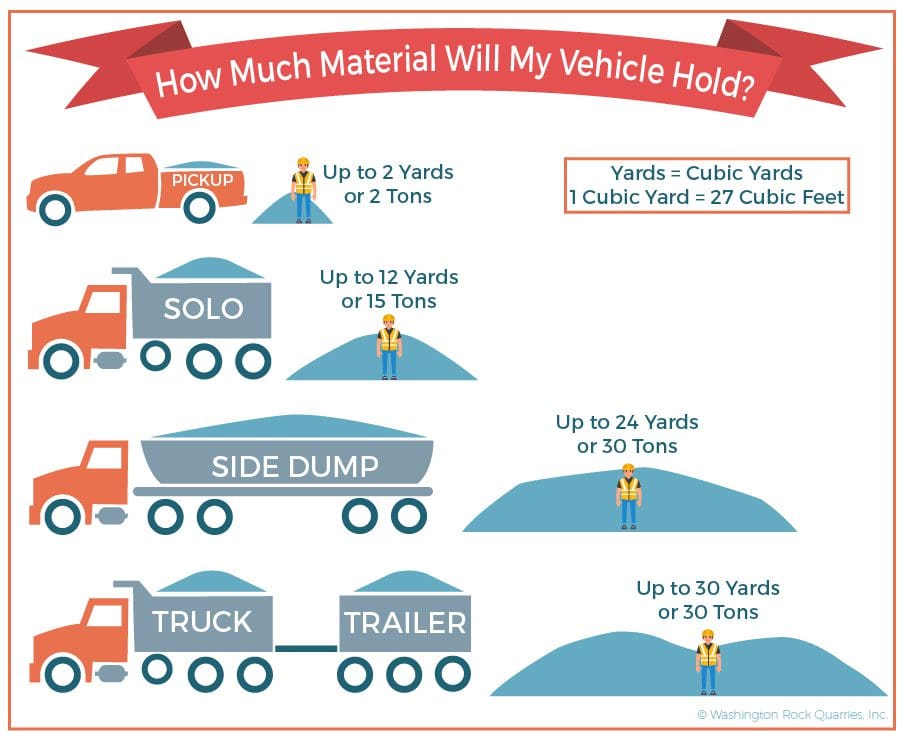
Image Source: www.wa-rock.com
Deciphering Volume and Weight
Before we dive into specific conversions, it’s crucial to grasp the difference between volume and weight. Think of it like this: a cubic yard is the space something occupies, like a box. A ton is how heavy that something is. You can have a cubic yard of feathers, which would be very light, or a cubic yard of lead, which would be very heavy. The key difference is the density of materials. Density is a measure of how much mass is packed into a given volume.
Cubic Yard Measurements Explained
A cubic yard is a measurement of volume. It represents a cube that is three feet long, three feet wide, and three feet high. Imagine a box roughly the size of a small refrigerator; that’s approximately one cubic yard.
- Length: 3 feet
- Width: 3 feet
- Height: 3 feet
- Total Volume: 3 ft x 3 ft x 3 ft = 27 cubic feet
When you’re ordering landscaping materials like soil, gravel, or mulch, they are typically sold by the cubic yard. However, when you’re thinking about how much you’ll need for a project or how to transport it, knowing the weight of cubic yard becomes important.
Tons and Weight Conversions
A ton is a unit of weight. In the United States, a ton is commonly referred to as a “short ton,” which is equal to 2,000 pounds. In other parts of the world, a “long ton” (2,240 pounds) or a “metric ton” (2,204.6 pounds) might be used. For most construction and landscaping purposes in the U.S., we’ll stick with the short ton.
Material Density Cubic Yard: The Missing Link
The magic number that connects volume (cubic yards) to weight (tons) is material density cubic yard. This tells you how much does a cubic yard weigh for a specific substance. Density is usually expressed in pounds per cubic foot or pounds per cubic yard. Once you have this density figure, you can easily calculate the tons per cubic yard.
The general formula for converting volume to weight is:
Weight = Volume × Density
And to get tons in a yard, you’ll divide the weight in pounds by 2,000 (since there are 2,000 pounds in a ton).
Tons per Cubic Yard = (Density in Pounds per Cubic Yard) / 2,000
Common Materials and Their Weights
Let’s explore the weight of cubic yard for some common materials used in construction and landscaping. Remember that these are averages, and the exact weight can vary based on moisture content, compaction, and the specific composition of the material.
Gravel and Crushed Stone
Gravel and crushed stone are popular for driveways, walkways, and drainage. Their weight can vary significantly depending on the type of rock and its size.
- Typical Density: 2,500 to 3,000 pounds per cubic yard.
Using an average density of 2,750 pounds per cubic yard:
Tons per Cubic Yard = 2,750 lbs / 2,000 lbs/ton = 1.375 tons
So, one cubic yard of gravel is roughly 1.375 tons.
Gravel Weight Table
| Material Type | Approx. Density (lbs/cu yd) | Tons per Cubic Yard (Approx.) |
|---|---|---|
| Clean Gravel | 2,500 – 2,800 | 1.25 – 1.40 |
| Crushed Stone (3/4″) | 2,700 – 3,000 | 1.35 – 1.50 |
| River Rock | 2,600 – 2,900 | 1.30 – 1.45 |
Sand
Sand is another essential material for various projects, from concrete mixes to base layers.
- Typical Density: 2,600 to 3,000 pounds per cubic yard.
Using an average density of 2,800 pounds per cubic yard:
Tons per Cubic Yard = 2,800 lbs / 2,000 lbs/ton = 1.4 tons
One cubic yard of sand is approximately 1.4 tons.
Sand Weight Table
| Material Type | Approx. Density (lbs/cu yd) | Tons per Cubic Yard (Approx.) |
|---|---|---|
| Play Sand | 2,600 – 2,800 | 1.30 – 1.40 |
| Concrete Sand | 2,800 – 3,000 | 1.40 – 1.50 |
| Builder’s Sand | 2,700 – 2,900 | 1.35 – 1.45 |
Topsoil
Topsoil is the uppermost layer of soil, rich in organic matter. Its weight can be highly variable due to moisture and organic content.
- Typical Density: 2,000 to 2,800 pounds per cubic yard.
Using an average density of 2,400 pounds per cubic yard:
Tons per Cubic Yard = 2,400 lbs / 2,000 lbs/ton = 1.2 tons
One cubic yard of topsoil is approximately 1.2 tons.
Topsoil Weight Table
| Material Type | Approx. Density (lbs/cu yd) | Tons per Cubic Yard (Approx.) |
|---|---|---|
| Dry Topsoil | 2,000 – 2,400 | 1.00 – 1.20 |
| Moist Topsoil | 2,400 – 2,800 | 1.20 – 1.40 |
| Compost-Amended Soil | 1,800 – 2,200 | 0.90 – 1.10 |
Mulch
Mulch, often made from wood chips or bark, is used to retain soil moisture and suppress weeds. It’s generally lighter than gravel or sand.
- Typical Density: 500 to 1,000 pounds per cubic yard (can be much lower for fluffy wood chips).
Using an average density of 750 pounds per cubic yard:
Tons per Cubic Yard = 750 lbs / 2,000 lbs/ton = 0.375 tons
One cubic yard of mulch is approximately 0.375 tons, or about 1,500 pounds.
Mulch Weight Table
| Material Type | Approx. Density (lbs/cu yd) | Tons per Cubic Yard (Approx.) |
|---|---|---|
| Wood Chips (Dry) | 500 – 700 | 0.25 – 0.35 |
| Bark Mulch (Moist) | 800 – 1,000 | 0.40 – 0.50 |
| Shredded Bark | 600 – 900 | 0.30 – 0.45 |
Concrete Mix
When ordering ready-mix concrete, it’s typically sold by the cubic yard. The weight of concrete is a crucial factor for structural considerations.
- Typical Density: 3,800 to 4,000 pounds per cubic yard.
Using an average density of 3,900 pounds per cubic yard:
Tons per Cubic Yard = 3,900 lbs / 2,000 lbs/ton = 1.95 tons
One cubic yard of concrete is approximately 1.95 tons.
Concrete Mix Weight Table
| Material Type | Approx. Density (lbs/cu yd) | Tons per Cubic Yard (Approx.) |
|---|---|---|
| Standard Concrete Mix | 3,800 – 4,000 | 1.90 – 2.00 |
| Lightweight Concrete Mix | 2,500 – 3,500 | 1.25 – 1.75 |
Asphalt
Asphalt, used for paving roads and driveways, has a significant weight.
- Typical Density: 3,800 to 4,200 pounds per cubic yard.
Using an average density of 4,000 pounds per cubic yard:
Tons per Cubic Yard = 4,000 lbs / 2,000 lbs/ton = 2.0 tons
One cubic yard of asphalt is approximately 2.0 tons.
Asphalt Weight Table
| Material Type | Approx. Density (lbs/cu yd) | Tons per Cubic Yard (Approx.) |
|---|---|---|
| Hot Mix Asphalt | 3,800 – 4,200 | 1.90 – 2.10 |
Rocks and Boulders
Larger rocks and boulders are often sold by the piece or by weight, but their volume can be estimated. Their density will depend heavily on the type of rock (granite, limestone, etc.).
- Typical Density: 2,500 to 3,000 pounds per cubic yard for crushed rock, but solid boulders can be denser.
Soil vs. Dirt
It’s worth noting the distinction between “soil” and “dirt.” While often used interchangeably, “soil” typically implies a healthier, more organic mixture suitable for planting. “Dirt” can refer to less refined earth. Their densities can differ, with soil often being slightly less dense due to its organic component, especially when dry.
Factors Affecting Cubic Yard Weight
Several factors can influence the weight of cubic yard of any given material. Accurate estimating material weight requires considering these:
1. Moisture Content
This is perhaps the most significant factor. Wet materials weigh considerably more than dry materials.
* Example: Dry sand might weigh 2,600 lbs per cubic yard, while wet sand could weigh 3,000 lbs per cubic yard or more. This means the tons per cubic yard can change based on recent rainfall or if the material has been watered.
2. Compaction
How tightly packed a material is affects its density.
* Loose Material: When first delivered, materials like mulch or gravel are often loosely packed.
* Compacted Material: After being driven over or walked on, these materials will settle and become denser, increasing their weight per cubic yard.
3. Material Composition and Type
Even within a general category like “gravel,” the specific rock types, their mineral composition, and particle sizes will influence density.
* For instance, granite is generally denser than limestone.
4. Particle Size and Shape
Smaller particles can pack more tightly than larger, irregularly shaped ones, potentially increasing density. However, the voids between particles also play a role.
Practical Applications of Cubic Yard to Ton Conversion
Knowing how many tons is in a cubic yard is essential for various practical reasons:
1. Transportation and Logistics
- Truck Capacity: Knowing the weight of materials helps determine how much you can legally and safely haul in a truck or trailer. Overloading can lead to fines, damage to your vehicle, and safety hazards.
- Delivery Costs: Some suppliers charge delivery fees based on weight.
2. Project Planning and Budgeting
- Ordering Materials: You can more accurately estimate how much material you need by considering its weight if you’re working with weight-based quantities or need to calculate transport costs.
- Cost Estimation: If materials are priced by weight, your cubic yard to ton conversion is vital for budgeting.
3. Construction and Engineering
- Structural Load Calculations: In construction, the weight of materials like concrete, fill dirt, or aggregate is critical for calculating the loads on foundations, bridges, and other structures.
- Excavation and Backfill: Estimating the weight of excavated material helps in planning for disposal or transport.
4. Landscaping Projects
- Calculating Required Amounts: Whether it’s for a new garden bed, a patio base, or a driveway, knowing the weight helps in planning.
- Choosing Equipment: For large projects, knowing the weight of materials can inform the type of machinery needed for moving and spreading.
Making Your Own Cubic Yard to Ton Conversion
If you have a specific material not listed, you can perform your own conversion with a few steps:
- Find the Material’s Density: Look for the density of your specific material. Reputable suppliers often provide this information. You can also find density charts online from geological surveys, agricultural extensions, or construction industry resources. Ensure the density is in pounds per cubic foot (lbs/cu ft) or pounds per cubic yard (lbs/cu yd).
- Convert to Pounds per Cubic Yard (if needed): If you have density in lbs/cu ft, multiply by 27 (since there are 27 cubic feet in a cubic yard) to get lbs/cu yd.
- Density in lbs/cu yd = Density in lbs/cu ft × 27
- Calculate Tons per Cubic Yard: Divide the density in pounds per cubic yard by 2,000.
- Tons per Cubic Yard = (Density in lbs/cu yd) / 2,000
Example:
Let’s say you find that a specific type of crushed rock has a density of 100 lbs/cu ft.
- Density in lbs/cu yd: 100 lbs/cu ft × 27 cu ft/cu yd = 2,700 lbs/cu yd
- Tons per Cubic Yard: 2,700 lbs/cu yd / 2,000 lbs/ton = 1.35 tons/cu yd
This process allows for precise volume to weight conversion for any material, helping with estimating material weight for your specific needs.
Frequently Asked Questions (FAQ)
Q: How much does a cubic yard of soil weigh?
A: A cubic yard of soil typically weighs between 2,000 and 2,800 pounds, which is 1.0 to 1.4 tons. The exact weight depends on moisture content and organic matter.
Q: How many tons of gravel are in a cubic yard?
A: Generally, a cubic yard of gravel weighs between 2,500 and 3,000 pounds, or 1.25 to 1.5 tons.
Q: Does the weight of a cubic yard change if it’s wet?
A: Yes, wet materials are significantly heavier than dry ones. Moisture adds considerable weight, so a cubic yard of wet sand will weigh more than a cubic yard of dry sand.
Q: Where can I find the density of specific materials?
A: You can often find density information from your material supplier, in construction or landscaping guides, or through online resources from reputable industry organizations.
Q: Is the conversion from cubic yards to tons always the same?
A: No, the conversion is not fixed. It entirely depends on the density of the specific material being measured. There isn’t a single number for how many tons in a yard without knowing the material.
Q: Why is it important to know the weight of materials in cubic yards?
A: It’s crucial for transportation logistics (e.g., truck weight limits), project planning, material ordering, and accurate budgeting, especially when costs are tied to weight or when dealing with structural load considerations.
By correctly applying these cubic yard to ton conversion principles, you can confidently tackle your projects, ensuring you have the right materials and manage them efficiently.