
So, how many cubic feet are in 1 cubic yard? There are 27 cubic feet in 1 cubic yard. This fundamental measurement is crucial for anyone dealing with construction, landscaping, or any project involving bulk materials. This guide will walk you through the simple math and provide practical examples to help you master cubic measurement.
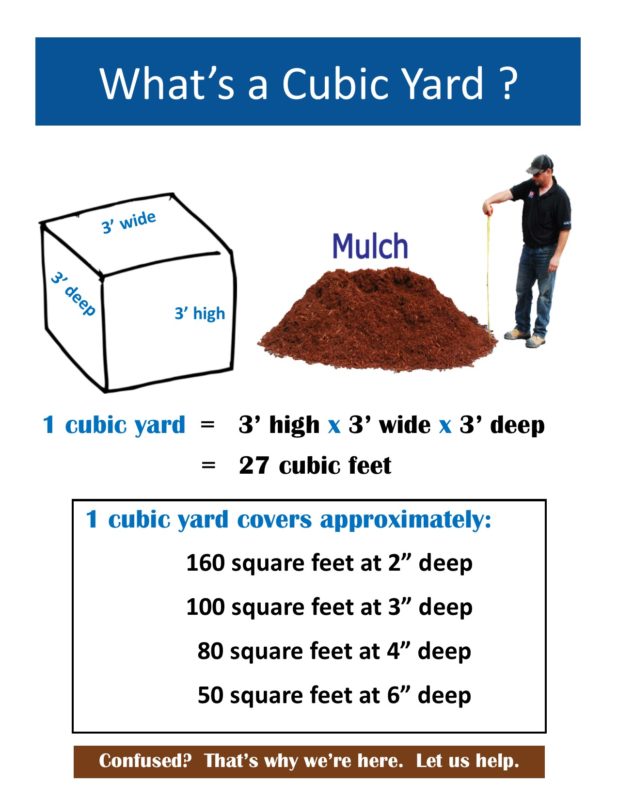
Image Source: stonegarden-nc.com
Decoding Cubic Measurements
Before we dive into the direct conversion, let’s clarify what we mean by cubic feet and cubic yards. These terms refer to units of volume, which is the amount of three-dimensional space an object occupies. Think of it as the “how much stuff fits inside” measurement.
What is a Cubic Foot?
A cubic foot is a unit of volume in the imperial and U.S. customary systems. It’s defined as the volume of a cube with sides that are each one foot long. Imagine a perfect cube, where the length, width, and height are all exactly 12 inches (or 1 foot). The space inside that cube is one cubic foot.
- Dimensions: 1 foot x 1 foot x 1 foot
- Calculation: 1 ft * 1 ft * 1 ft = 1 cubic foot (cu ft or ft³)
What is a Cubic Yard?
Similarly, a cubic yard is a larger unit of volume. It’s the volume of a cube with sides that are each one yard long. Since one yard is equal to three feet, a cubic yard is a much bigger space than a cubic foot.
- Dimensions: 1 yard x 1 yard x 1 yard
- Calculation: 1 yd * 1 yd * 1 yd = 1 cubic yard (cu yd or yd³)
The Cubic Feet to Cubic Yards Conversion
Now, let’s connect these two units. The key to the cubic feet to cubic yards conversion lies in the relationship between a foot and a yard.
We know that:
1 yard = 3 feet
To find out how many cubic feet are in a cubic yard, we need to cube this relationship. This means we multiply the length, width, and height in feet, based on the yard measurement.
Calculation:
1 cubic yard = 1 yard * 1 yard * 1 yard
Substitute the equivalent in feet:
1 cubic yard = (3 feet) * (3 feet) * (3 feet)
Now, multiply the numbers and the units:
1 cubic yard = (3 * 3 * 3) * (feet * feet * feet)
1 cubic yard = 27 * cubic feet
Therefore, 1 cubic yard = 27 cubic feet.
This is the core of the cubic yard to cu ft conversion. Every cubic yard contains 27 cubic feet.
Visualizing the Conversion
Imagine a large cube that is 1 yard (or 3 feet) long, 1 yard (or 3 feet) wide, and 1 yard (or 3 feet) high.
Now, picture dividing each of those 3-foot sides into three 1-foot sections.
This creates a grid within the large cube. In terms of length, you have 3 sections. In terms of width, you have 3 sections. In terms of height, you have 3 sections.
The total number of smaller, 1-foot cubes within the larger, 1-yard cube is:
3 sections (length) * 3 sections (width) * 3 sections (height) = 27 sections.
Each of these smaller sections is a 1-foot cube, meaning each section is 1 cubic foot. So, the entire 1-cubic-yard space is filled with 27 individual cubic feet. This is a clear way to grasp how many cubic feet in a yard.
Converting Cubic Yards to Cubic Feet
The cubic yard to cubic feet conversion is straightforward once you have the core relationship (1 cu yd = 27 cu ft). To convert a quantity from cubic yards to cubic feet, you simply multiply the number of cubic yards by 27.
Formula:
Cubic Feet = Cubic Yards * 27
Example:
If you have 2 cubic yards of gravel, how many cubic feet is that?
Cubic Feet = 2 cu yd * 27 cu ft/cu yd
Cubic Feet = 54 cu ft
So, 2 cubic yards of gravel is equal to 54 cubic feet.
This is a fundamental aspect of volume conversion and is essential for accurately ordering and calculating material quantities.
Converting Cubic Feet to Cubic Yards
The reverse is also true. To convert a quantity from cubic feet to cubic yards, you divide the number of cubic feet by 27.
Formula:
Cubic Yards = Cubic Feet / 27
Example:
You have a pile of soil that measures 81 cubic feet. How many cubic yards is that?
Cubic Yards = 81 cu ft / 27 cu ft/cu yd
Cubic Yards = 3 cu yd
So, 81 cubic feet of soil is equal to 3 cubic yards.
This is the core of the cubic feet to cubic yards conversion process.
Practical Applications of Cubic Measurement
Understanding how to convert cubic yards to cubic feet is vital in many real-world scenarios. Let’s explore some common applications where this volume conversion is crucial.
Landscaping and Gardening
- Mulch and Soil: When you buy mulch, topsoil, or compost, it’s often sold by the cubic yard. If your garden bed needs 4 inches of topsoil and the area is 10 feet by 20 feet, you’ll need to calculate the volume.
- Length = 20 ft
- Width = 10 ft
- Depth = 4 inches = 4/12 feet = 0.333 feet
- Volume in cubic feet = 20 ft * 10 ft * 0.333 ft = 66.6 cubic feet
- Volume in cubic yards = 66.6 cu ft / 27 cu ft/cu yd = 2.47 cubic yards. You’d likely order 2.5 or 3 cubic yards to be safe.
- Gravel and Stone: Driveways, pathways, and decorative rock beds often use gravel. Knowing the cubic yard capacity needed ensures you order the right amount. For instance, a driveway that’s 100 feet long, 10 feet wide, and needs 6 inches (0.5 feet) of gravel:
- Volume in cubic feet = 100 ft * 10 ft * 0.5 ft = 500 cubic feet
- Volume in cubic yards = 500 cu ft / 27 cu ft/cu yd = 18.52 cubic yards. You’d order 18.5 or 19 cubic yards.
Construction Projects
- Concrete: Concrete is typically ordered by the cubic yard. Whether you’re pouring a patio, a foundation, or a sidewalk, accurate cubic measurement is essential to avoid over-ordering or running short. If a concrete slab needs to be 12 feet long, 10 feet wide, and 6 inches (0.5 feet) thick:
- Volume in cubic feet = 12 ft * 10 ft * 0.5 ft = 60 cubic feet
- Volume in cubic yards = 60 cu ft / 27 cu ft/cu yd = 2.22 cubic yards. You’d likely order 2.5 cubic yards of concrete.
- Fill Dirt and Excavation: When excavating a site or adding fill dirt, contractors work with cubic yards. If an excavation needs to be 30 feet long, 20 feet wide, and 5 feet deep:
- Volume in cubic feet = 30 ft * 20 ft * 5 ft = 3000 cubic feet
- Volume in cubic yards = 3000 cu ft / 27 cu ft/cu yd = 111.11 cubic yards.
DIY Home Projects
- Gravel for a Path: If you’re building a garden path that’s 50 feet long, 3 feet wide, and you want 3 inches (0.25 feet) of gravel:
- Volume in cubic feet = 50 ft * 3 ft * 0.25 ft = 37.5 cubic feet
- Volume in cubic yards = 37.5 cu ft / 27 cu ft/cu yd = 1.39 cubic yards. You might buy 1.5 cubic yards.
- Sand for a Sandbox: A sandbox that is 8 feet by 8 feet and needs 1 foot of sand:
- Volume in cubic feet = 8 ft * 8 ft * 1 ft = 64 cubic feet
- Volume in cubic yards = 64 cu ft / 27 cu ft/cu yd = 2.37 cubic yards. You’d need to order around 2.5 cubic yards of sand.
Working with Different Units: Yardage to Cubic Feet
Sometimes, you might encounter measurements in yards that aren’t explicitly cubic yards. For example, you might have a length of material measured in yards, or a quantity of material expressed as “yardage” in a less formal sense.
If you’re given a yardage to cubic feet conversion, the primary conversion factor remains the same: 1 cubic yard is 27 cubic feet. The key is to ensure you are working with volumes, not just linear distances.
For instance, if a supplier refers to “a yard of gravel,” they almost certainly mean a cubic yard. This is a common shorthand in the industry.
Scenario: A customer asks for “two yards of mulch.” This implies two cubic yards.
- To find the cubic feet: 2 cubic yards * 27 cubic feet/cubic yard = 54 cubic feet.
This demonstrates how the core relationship of cubic yard to cu ft is applied consistently, regardless of how the quantity is initially phrased.
Tables for Quick Reference
To make things even easier, here are a couple of quick reference tables.
Table 1: Cubic Yards to Cubic Feet Conversion
| Cubic Yards (cu yd) | Cubic Feet (cu ft) | Calculation (cu yd * 27) |
|---|---|---|
| 1 | 27 | 1 * 27 = 27 |
| 2 | 54 | 2 * 27 = 54 |
| 3 | 81 | 3 * 27 = 81 |
| 4 | 108 | 4 * 27 = 108 |
| 5 | 135 | 5 * 27 = 135 |
| 10 | 270 | 10 * 27 = 270 |
| 20 | 540 | 20 * 27 = 540 |
Table 2: Cubic Feet to Cubic Yards Conversion
| Cubic Feet (cu ft) | Cubic Yards (cu yd) | Calculation (cu ft / 27) |
|---|---|---|
| 27 | 1 | 27 / 27 = 1 |
| 54 | 2 | 54 / 27 = 2 |
| 81 | 3 | 81 / 27 = 3 |
| 108 | 4 | 108 / 27 = 4 |
| 135 | 5 | 135 / 27 = 5 |
| 270 | 10 | 270 / 27 = 10 |
| 540 | 20 | 540 / 27 = 20 |
These tables highlight the simple multiplication or division by 27 for accurate volume conversion.
Calculating Cubic Footage
When you need to determine the cubic footage of an object or space, you measure its length, width, and height in the same unit (usually feet for cubic measurement projects). Then, you multiply these three dimensions together.
Formula for Cubic Footage:
Cubic Footage = Length × Width × Height
Steps:
- Measure: Measure the length, width, and height of the area or material in feet.
- Multiply: Multiply these three measurements together.
- Convert (if needed): If your final calculation is in cubic feet and you need it in cubic yards, divide the cubic feet by 27.
Example:
You want to know the cubic footage of a rectangular garden bed that is 15 feet long, 5 feet wide, and 1 foot deep (for adding compost).
- Length = 15 feet
- Width = 5 feet
- Height (Depth) = 1 foot
Cubic Footage = 15 ft * 5 ft * 1 ft = 75 cubic feet.
Now, if you need to know this in cubic yards:
Cubic Yards = 75 cu ft / 27 cu ft/cu yd = 2.78 cubic yards.
This illustrates how to determine your cubic yard capacity requirements through simple calculations.
Common Mistakes to Avoid
While the conversion is simple, there are a few common pitfalls:
- Confusing Linear and Cubic Measurements: Remember that a yard is a measure of length, while a cubic yard is a measure of volume. Don’t mix these up. For example, a fence that is 10 yards long is 30 feet long, but this doesn’t directly tell you its cubic volume.
- Forgetting to Cube the Conversion Factor: When converting length (feet to yards), you divide by 3. When converting area (square feet to square yards), you divide by 9 (3 ft * 3 ft = 9 sq ft). For volume (cubic feet to cubic yards), you must divide by 27 (3 ft * 3 ft * 3 ft = 27 cu ft).
- Inaccurate Measurements: Even small errors in measuring length, width, or height can lead to significant differences in your final volume calculation, especially for large projects. Always double-check your measurements.
Frequently Asked Questions (FAQ)
Q1: How do I convert a length in yards to cubic feet?
You cannot directly convert a length in yards to cubic feet. Yards measure length, while cubic feet measure volume. You need to have three dimensions (length, width, height) measured in feet to calculate cubic feet.
Q2: If I order “one yard” of sand, what does that mean?
In most construction and landscaping contexts, “one yard” refers to one cubic yard. So, one yard of sand is equivalent to 27 cubic feet of sand.
Q3: My project requires 3 cubic yards of gravel. How much is that in cubic feet?
To convert cubic yards to cubic feet, multiply by 27.
3 cubic yards * 27 cubic feet/cubic yard = 81 cubic feet.
Q4: I measured my garden bed in feet, and it’s 10ft x 8ft x 0.5ft. How many cubic yards of soil do I need?
First, calculate the volume in cubic feet:
10 ft * 8 ft * 0.5 ft = 40 cubic feet.
Then, convert cubic feet to cubic yards by dividing by 27:
40 cubic feet / 27 cubic feet/cubic yard ≈ 1.48 cubic yards.
You would likely order 1.5 cubic yards.
Q5: Is there a difference between cu ft and cubic ft?
No, “cu ft” is simply a common abbreviation for “cubic feet.” They mean the exact same thing.
Conclusion
Mastering the cubic feet to cubic yards conversion is a valuable skill for anyone undertaking projects involving materials like soil, gravel, mulch, or concrete. The fundamental relationship is simple: 1 cubic yard equals 27 cubic feet. By remembering this and applying the straightforward multiplication or division, you can accurately calculate your needs, avoid waste, and ensure your projects run smoothly. Whether you’re a seasoned contractor or a DIY enthusiast, this volume conversion knowledge will serve you well.