
So, how do you figure out a square yard? You measure the length and width of the area in feet, multiply those two numbers together to get the square footage, and then divide that result by 9 to get the square yards. This process is key for many projects around your home or for landscaping.
When you need to calculate square yardage, knowing the steps makes it easy. Whether you’re buying carpet, ordering soil, or planning a patio, square yard measurement is a common need. We’ll break down how to measure land area and perform a yardage calculation formula so you can tackle any project with confidence.
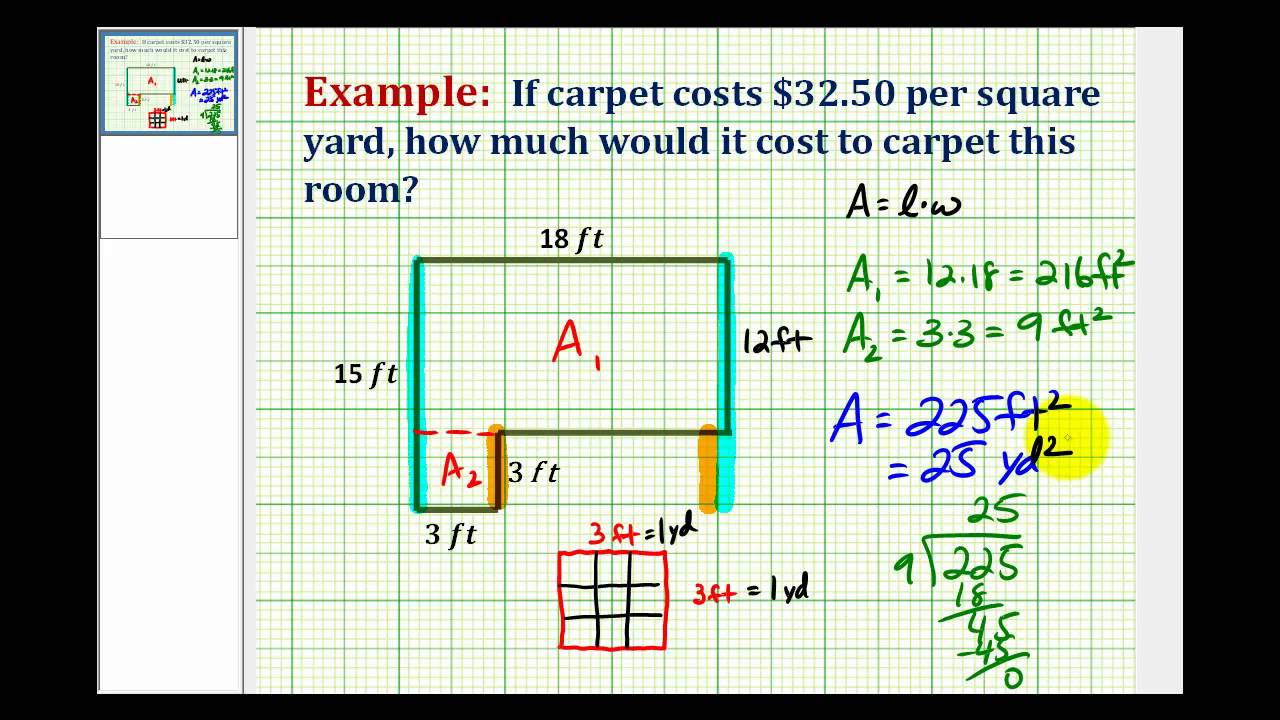
Image Source: i.ytimg.com
Why Measure in Square Yards?
You might wonder why we use square yards when feet and inches are often more familiar. Square yards are particularly useful for larger areas, like yards, gardens, and even rooms, because they represent a larger unit of measurement. This means you deal with smaller numbers, which can simplify calculations and purchasing. For instance, buying 50 square yards of sod is easier to visualize than 450 square feet.
Common Uses for Square Yard Measurement:
- Flooring: Carpet, tile, and hardwood are often sold by the square yard.
- Landscaping: Soil, mulch, gravel, and sod are typically priced per square yard.
- Construction: When estimating materials for patios, driveways, or even small structures, square yards are a standard.
- Room Planning: Figuring out the calculating room size for furniture placement or paint can be done in square yards.
Fathoming the Basics: Feet, Square Feet, and Square Yards
Before we dive into the calculations, let’s clarify the terms.
- Foot (ft): A unit of length.
- Square Foot (sq ft): A unit of area. It’s the area of a square that is one foot on each side (1 ft x 1 ft).
- Yard (yd): A unit of length, equal to 3 feet.
- Square Yard (sq yd): A unit of area. It’s the area of a square that is one yard on each side (1 yd x 1 yd).
The Crucial Relationship: Converting Feet to Square Yards
The most important conversion to remember is between feet and yards. Since 1 yard = 3 feet, a square yard is a bit more involved.
Imagine a square that is 1 yard by 1 yard.
* In feet, this is 3 feet by 3 feet.
* The area of this square is 3 feet * 3 feet = 9 square feet.
Therefore, 1 square yard = 9 square feet. This is the golden rule for converting between square feet and square yards.
Simple Steps to Calculate Square Yardage
Now, let’s get to the “how-to.”
Step 1: Measure the Length and Width
This is the first and most critical step in any area calculation. You need to accurately measure the dimensions of the space you want to cover.
How to Measure a Yard (or Any Rectangular Area):
- Use a Measuring Tape: A long measuring tape (at least 50 feet or 100 feet) is ideal for larger areas like yards. For smaller spaces like rooms, a standard 25-foot tape measure will work.
- Measure in Feet: For these calculations, it’s easiest to measure in feet. If your measurements are in inches, convert them to feet by dividing by 12.
- Straight Lines: Ensure your tape measure is pulled taut and straight along the edge of the area.
- Identify the Length and Width: For a simple rectangular or square area, you’ll measure two sides that meet at a corner.
Example: You’re measuring a garden bed.
* Measure one side: It’s 10 feet long.
* Measure the adjacent side (the width): It’s 4 feet wide.
Step 2: Calculate the Area in Square Feet
Once you have your length and width in feet, you multiply them together. This gives you the square footage of the area.
Yardage Calculation Formula (for Rectangles/Squares):
Area (sq ft) = Length (ft) × Width (ft)
Example (Continuing from above):
* Length = 10 feet
* Width = 4 feet
* Area = 10 ft × 4 ft = 40 sq ft
This means your garden bed has an area of 40 square feet.
Step 3: Convert Square Feet to Square Yards
This is where our golden rule comes in! Since 1 square yard equals 9 square feet, you divide your square footage by 9.
Convert Feet to Square Yards:
Area (sq yd) = Area (sq ft) / 9
Example (Continuing from above):
* Area (sq ft) = 40 sq ft
* Area (sq yd) = 40 sq ft / 9 = 4.44 sq yd (approximately)
So, your garden bed needs about 4.44 square yards of material.
Important Note: When buying materials, you often can’t buy fractions of a square yard. It’s usually best to round up to the nearest whole or half square yard to ensure you have enough. In this case, you’d likely buy 4.5 or 5 square yards.
Handling Irregular Shapes: Area Calculation Made Easier
Most areas aren’t perfect rectangles. Here’s how to tackle common irregular shapes. The goal is always to break them down into simpler shapes or approximate them.
Triangles
If you have a triangular area (like a corner of your yard), you’ll need its base and its height. The height is the perpendicular distance from the base to the opposite point.
Triangle Area Formula:
Area (sq ft) = (Base (ft) × Height (ft)) / 2
Example: A triangular section of your lawn has a base of 12 feet and a height of 8 feet.
* Area (sq ft) = (12 ft × 8 ft) / 2 = 96 sq ft / 2 = 48 sq ft
* Now, convert to square yards: 48 sq ft / 9 = 5.33 sq yd. You’d round up to 5.5 or 6 sq yd.
Circles
For circular areas, like a round patio or a tree well, you’ll need the radius. The radius is the distance from the center of the circle to its edge. If you can only measure the diameter (the distance across the circle through the center), divide it by 2 to get the radius.
Circle Area Formula:
Area (sq ft) = π × Radius (ft)²
(Where π (pi) is approximately 3.14159)
Example: A circular flower bed has a diameter of 6 feet.
* First, find the radius: Radius = Diameter / 2 = 6 ft / 2 = 3 ft
* Now, calculate the area in square feet: Area = 3.14159 × (3 ft)² = 3.14159 × 9 sq ft = 28.27 sq ft (approx.)
* Convert to square yards: 28.27 sq ft / 9 = 3.14 sq yd (approx.)
* You would likely buy 3.5 square yards.
L-Shaped Areas or Complex Polygons
For shapes that are more complicated, like an L-shape or a polygon with many sides, the best strategy is to break them into smaller, manageable rectangles and squares.
Steps for Complex Shapes:
- Sketch the Area: Draw a simple diagram of your space.
- Divide and Conquer: Draw lines on your sketch to divide the complex shape into several rectangles, squares, or triangles.
- Measure Each Section: Measure the length and width (or base and height) of each of these smaller shapes.
- Calculate Area for Each Section: Use the appropriate formula for each shape to find its area in square feet.
- Sum the Areas: Add up the square footage of all the individual sections to get the total area in square feet.
- Convert to Square Yards: Divide the total square footage by 9.
Example: Imagine a patio that is an L-shape.
-
Shape Description: It’s like a large rectangle with a smaller rectangle cut out of one corner, or two rectangles joined together. Let’s assume it’s two rectangles joined.
- Rectangle A: 10 ft x 12 ft
- Rectangle B: 8 ft x 5 ft (joined to the side of Rectangle A)
-
Calculate Area for Each:
- Rectangle A Area = 10 ft × 12 ft = 120 sq ft
- Rectangle B Area = 8 ft × 5 ft = 40 sq ft
-
Total Area in Square Feet:
- Total Area = 120 sq ft + 40 sq ft = 160 sq ft
-
Convert to Square Yards:
- Total Area (sq yd) = 160 sq ft / 9 = 17.78 sq yd (approx.)
- You would likely purchase 18 square yards of material.
Tip: Make sure your measurements account for the overall dimensions and don’t overlap measurements when dividing into sections.
Surface Area Measurement vs. Ground Area
It’s important to distinguish between surface area measurement and ground area. When we talk about how to measure a yard or calculating room size for flooring or landscaping, we are generally referring to the flat, horizontal surface area.
- Ground Area: This is what we’ve been calculating – the 2D area of the surface.
- Surface Area: This term can sometimes include vertical surfaces (like walls) or complex 3D shapes. For most yardage calculations for materials like sod, mulch, or carpet, you’re interested in the ground area.
If you were painting a wall or calculating the amount of siding needed, you would be dealing with vertical surface area, which involves measuring the height and width of the walls.
Practical Tips for Accurate Yardage Calculation
- Double-Check Measurements: It’s always a good idea to measure twice and cut once, or in this case, calculate twice and buy once. A small error in measurement can lead to buying too much or too little material.
- Account for Waste: For materials like carpet or tile, it’s common practice to add an extra 5-10% to your total square yardage to account for cuts, mistakes, and waste.
- Check Product Specifications: Different materials might have slightly different coverage rates or be sold in specific roll widths. Always check the manufacturer’s recommendations.
- Sketch Your Layout: For larger or more complex areas, drawing a scaled sketch can help visualize the layout and ensure accurate measurements of all sections.
Frequently Asked Questions (FAQ)
Q1: What is a square yard used for?
A1: A square yard is a unit of area commonly used for flooring (carpet, tile), landscaping materials (soil, mulch, sod), and estimating for construction projects like patios and driveways.
Q2: Can I measure my yard in meters and convert to square yards?
A2: Yes, you can. First, convert your meter measurements to feet (1 meter ≈ 3.28 feet). Then, calculate the area in square feet and finally convert to square yards by dividing by 9. Or, you can convert meters to yards directly (1 meter ≈ 1.09 yards) and then calculate the area in square yards.
Q3: How do I convert feet to square yards if my measurements are not in whole feet?
A3: If you have measurements in feet and inches, first convert the inches to feet by dividing by 12. For example, 6 inches is 0.5 feet. Then, multiply your length (in feet) by your width (in feet) to get square feet, and finally divide by 9 to get square yards.
Q4: What if my area is not a simple rectangle? How do I measure it?
A4: For irregular shapes, break them down into smaller, simpler shapes like rectangles, squares, triangles, or circles. Measure each small shape, calculate its area, and then add all the areas together to get the total square footage. Then, convert to square yards.
Q5: How much extra material should I buy when calculating square yards?
A5: It’s generally recommended to add 5-10% extra material for waste due to cuts, mistakes, or irregular layouts, especially for materials like carpet or tile.
Q6: Why is it better to calculate in square yards than square feet for large areas?
A6: Using square yards for large areas results in smaller, more manageable numbers, making calculations easier and reducing the chance of errors. It’s also how many materials are priced and sold.
By following these simple steps, you can accurately calculate square yardage for any project, ensuring you get the right amount of material and a professional-looking result. Happy measuring!