
A cubic yard of concrete weighs approximately 4,050 pounds. This foundational information is crucial for anyone involved in construction, landscaping, or even large DIY projects. Knowing the weight of concrete per cubic yard helps with planning, material ordering, transportation logistics, and ensuring the structural integrity of your project. This article will delve deep into the factors influencing concrete weight and provide you with the knowledge to make informed decisions.
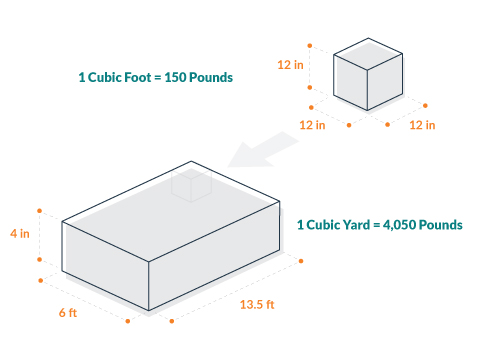
Image Source: www.dumpsters.com
Deciphering Concrete Density and Its Weight
The weight of concrete is not a fixed number; it varies based on its composition. The primary factor influencing how much does concrete weigh is its concrete density. Density, in simple terms, is how much “stuff” is packed into a certain space. For concrete, this “stuff” includes cement, water, sand, gravel (aggregates), and sometimes additives.
The Role of Aggregates
Aggregates are the backbone of concrete, making up the largest portion of its volume. The type and density of these aggregates have a significant impact on the overall weight of a cubic yard of concrete weight.
- Sand and Gravel: The most common aggregates are sand (fine aggregate) and gravel or crushed stone (coarse aggregate). Denser aggregates, like granite or basalt, will result in heavier concrete compared to lighter aggregates, such as limestone or slag.
- Aggregate Size and Gradation: The size and distribution of aggregate particles also play a role. A well-graded mix, meaning it has a good distribution of particle sizes, will pack more tightly, potentially increasing density and weight.
Cement and Water Ratios
While aggregates form the bulk, the cement paste (cement mixed with water) binds everything together.
- Cement Content: Higher cement content generally leads to denser, stronger, and heavier concrete.
- Water-Cement Ratio: The amount of water used in the mix affects the concrete density. Too much water can lead to a weaker, less dense concrete. Conversely, a carefully controlled, lower water-cement ratio is essential for achieving high strength and density.
Air Entrainment and Additives
Sometimes, air is intentionally introduced into concrete to improve its resistance to freeze-thaw cycles.
- Air Entrainment: Entrained air pockets reduce the overall density and, consequently, the weight of the concrete.
- Admixtures: Various chemical admixtures can be added to alter concrete’s properties. Some may increase density, while others, like air-entraining agents, will decrease it.
Fathoming the Weight of Concrete Per Cubic Yard
So, how much does a cubic yard of concrete weigh? As mentioned, the average weight is around 4,050 pounds. However, this is a general figure. To provide a more precise concrete weight estimate, let’s break down the typical variations.
Typical Weight Ranges
The weight of concrete per cubic yard can range from approximately 3,500 pounds to over 4,500 pounds. This variation is primarily driven by the aggregate type and the mix design.
- Lightweight Concrete: Typically uses lightweight aggregates like expanded shale, clay, or slate. This can bring the weight down to as low as 90-115 pounds per cubic foot, translating to roughly 2,430-3,105 pounds per cubic yard.
- Normal Weight Concrete: This is the most common type, using standard sand and gravel. As established, this usually falls in the 4,000-4,050 pounds per cubic yard range.
- Heavyweight Concrete: This uses very dense aggregates, such as barite or magnetite, and is often used for radiation shielding. Its weight can be significantly higher, potentially reaching 15,000 pounds per cubic yard or more.
Calculating Concrete Weight
For most construction and DIY projects, you’ll be dealing with normal weight concrete. If you need to calculate the concrete weight estimate for a specific project, you’ll need to know the concrete density of your mix.
Formula for Calculating Concrete Weight
The fundamental formula to determine the weight of concrete is:
Weight = Volume × Density
However, density is often expressed in pounds per cubic foot (pcf) or kilograms per cubic meter (kg/m³). Since we are interested in a cubic yard of concrete weight, we need to convert units appropriately.
- 1 cubic yard = 27 cubic feet
If you know the density in pounds per cubic foot (pcf), you can calculate the weight of one cubic yard as follows:
Weight (lbs/cubic yard) = Density (pcf) × 27 (cubic feet/cubic yard)
Example: If your concrete mix has a density of 150 pcf, then the weight per cubic yard is:
150 pcf × 27 cubic feet/cubic yard = 4,050 pounds/cubic yard
Using a Concrete Weight Calculator
For convenience, many online resources offer a concrete weight calculator. These tools simplify the process by allowing you to input the dimensions of your concrete pour (length, width, and depth) and often the estimated density or type of concrete, and they will provide the total weight. This is incredibly useful for calculating concrete weight for larger projects.
Practical Applications of Knowing Concrete Weight
Why is it so important to know how much does concrete weigh? The answer lies in its numerous practical applications in the real world.
Project Planning and Material Ordering
- Volume Calculation: Before ordering concrete, you need to accurately calculate the volume required for your project. For example, a concrete slab weight calculation for a patio might involve measuring its length, width, and thickness.
- Truck Capacity: Understanding the weight of concrete per cubic yard is vital when ordering from a concrete supplier. Concrete trucks have weight limits. Knowing the weight helps ensure you don’t exceed these limits, which could lead to fines or safety issues.
- Structural Considerations: For large structures, the weight of the concrete itself is a significant load. Architects and engineers use concrete density data to design foundations, beams, and columns that can support the immense weight of the concrete.
Transportation and Handling
- Delivery Logistics: Knowing the total weight of the concrete you need will influence the type of delivery truck required and the number of trips needed.
- Equipment Requirements: For smaller projects where you might be mixing concrete on-site or transporting pre-mixed bags, knowing the weight helps you determine if you have the necessary lifting equipment or enough people to handle the materials safely.
Cost Estimation
While concrete is often priced by the cubic yard, its weight can indirectly influence costs.
- Transportation Fees: Some suppliers might charge extra for deliveries requiring specialized trucks or if the weight of the load is particularly high.
- Reinforcement Needs: Heavier concrete structures may require more robust reinforcement (rebar), which adds to the overall project cost.
How to Weigh Concrete: Methods and Considerations
While most people rely on calculated weights, there are situations where actually how to weigh concrete directly might be necessary, especially for research or specialized applications.
Direct Weighing Methods
-
Weighing Mixed Concrete: This is challenging due to the wet, unformed state of freshly mixed concrete.
- Small Batches: For very small quantities, you could potentially weigh a known volume of wet concrete using a scale and a container of known volume. This requires precise measurement of both the container’s volume and the wet concrete within it.
- Large Batches: For larger amounts, this would involve weighing the empty truck or mixer, then weighing it again after it’s filled with concrete, and subtracting the difference. This gives the total weight of the concrete delivered but doesn’t isolate the weight of a specific cubic yard.
-
Weighing Cured Concrete Samples: This is a more practical method for determining the concrete density.
- Casting a Sample: Cast a small, precisely measured volume of concrete (e.g., a 1-foot cube or a cylindrical core) using the intended mix design.
- Curing: Allow the sample to cure for a standard period (usually 28 days) under controlled conditions to reach its full strength and stable density.
- Weighing: Weigh the cured sample using a calibrated scale.
- Calculating Density: Divide the weight of the cured sample by its precisely measured volume to determine its density in pounds per cubic foot (pcf).
Example: If a 1 cubic foot sample of cured concrete weighs 150 pounds, its density is 150 pcf.
Considerations When Weighing Concrete
- Moisture Content: The moisture content of concrete significantly affects its weight. Freshly mixed concrete will weigh more than cured concrete due to its water content. When determining density for calculations, it’s best to weigh cured samples.
- Compaction: The degree of compaction during placement also influences the final density. Poorly compacted concrete will have more air voids, reducing its density and weight.
- Accuracy of Measurements: Precision in measuring volume and weight is critical for accurate results.
Common Concrete Project Calculations
Let’s look at some common scenarios where you might need to perform these calculations.
Calculating the Weight of a Concrete Slab
A concrete slab weight calculation is one of the most frequent needs.
Example: You need to pour a patio slab that is 10 feet long, 8 feet wide, and 4 inches thick.
- Convert Thickness to Feet: 4 inches / 12 inches/foot = 0.333 feet
- Calculate Volume in Cubic Feet: 10 ft × 8 ft × 0.333 ft = 26.64 cubic feet
- Calculate Volume in Cubic Yards: 26.64 cubic feet / 27 cubic feet/cubic yard = 0.987 cubic yards
- Calculate Estimated Weight: Assuming a standard concrete density of 150 pcf (4,050 lbs/cubic yard):
0.987 cubic yards × 4,050 lbs/cubic yard = 3,997.35 pounds
So, the estimated weight of your patio slab is approximately 4,000 pounds.
Estimating the Weight of Footings
Foundations and footings are critical structural elements.
Example: You are building a foundation with footings that are 18 inches wide, 8 inches deep, and a total of 60 linear feet.
- Convert Dimensions to Feet:
- Width: 18 inches / 12 inches/foot = 1.5 feet
- Depth: 8 inches / 12 inches/foot = 0.667 feet
- Calculate Volume in Cubic Feet: 1.5 ft × 0.667 ft × 60 ft = 60.03 cubic feet
- Calculate Volume in Cubic Yards: 60.03 cubic feet / 27 cubic feet/cubic yard = 2.22 cubic yards
- Calculate Estimated Weight: Using 4,050 lbs/cubic yard:
2.22 cubic yards × 4,050 lbs/cubic yard = 8,991 pounds
The estimated weight of your footings is approximately 8,991 pounds.
Factors Affecting Concrete Weight in Practice
Beyond the mix design, several practical factors can influence the actual weight of concrete on a job site.
Moisture Content in Aggregates
- Wet Aggregates: Aggregates delivered to a batch plant may contain varying amounts of moisture. Wet aggregates add weight to the mix.
- Dry Aggregates: Very dry aggregates will absorb some water from the mix, potentially leading to a slightly lighter final product if not accounted for.
- Batch Plant Control: Reputable batch plants have systems to measure and adjust for aggregate moisture content to maintain consistent mix properties.
Curing Process
- Water Evaporation: As concrete cures, it loses some of its initial water content through evaporation. This means freshly poured concrete will weigh slightly more than the same volume after it has fully cured. However, for most practical purposes and ordering, the typical cured weight is used.
- Internal Hydration: The chemical reaction of hydration consumes water. While this water is incorporated into the concrete’s structure, the net effect over time is a slight reduction in free water, influencing weight.
Temperature Effects
While minor, temperature can have a slight effect on concrete’s density and thus its weight. However, for standard construction calculations, these variations are typically negligible.
Frequently Asked Questions (FAQ)
Q1: What is the standard weight of a cubic yard of concrete?
A1: The standard weight of a cubic yard of concrete is approximately 4,050 pounds. This can vary based on the specific mix design and aggregate type.
Q2: Does the type of aggregate affect the weight of concrete?
A2: Yes, the type of aggregate significantly affects the weight. Denser aggregates like granite will result in heavier concrete, while lighter aggregates will produce lighter concrete.
Q3: Can I calculate the weight of concrete for my project?
A3: Yes, you can calculate the weight of concrete by first determining the volume of your project (length × width × depth) and then multiplying it by the known concrete density per cubic yard. A concrete weight calculator can assist with this.
Q4: How does the water-cement ratio influence concrete weight?
A4: A lower water-cement ratio generally results in a denser and stronger concrete, which can also mean a slightly higher weight per cubic yard compared to a mix with a higher water-cement ratio.
Q5: If I’m ordering concrete, what information do I need?
A5: You need to know the required volume in cubic yards and the intended use of the concrete. Providing an estimated concrete weight estimate can also be helpful for the supplier regarding truck loading.
Q6: How to weigh concrete accurately?
A6: The most accurate way to determine the density of concrete is to cast a precisely measured sample, cure it properly, and then weigh it. For the weight of a poured structure, it’s usually calculated based on volume and known density.
Q7: Why is knowing the weight of concrete important?
A7: Knowing the weight of concrete per cubic yard is important for project planning, material ordering, transportation logistics, cost estimation, and ensuring structural stability, especially for large projects like a concrete slab weight.
In conclusion, how much does a cubic yard of concrete weigh is a question with a practical answer that underpins many construction decisions. By understanding the factors that contribute to concrete density and learning simple methods for calculating concrete weight, you can confidently plan and execute your projects, ensuring both efficiency and structural soundness.