
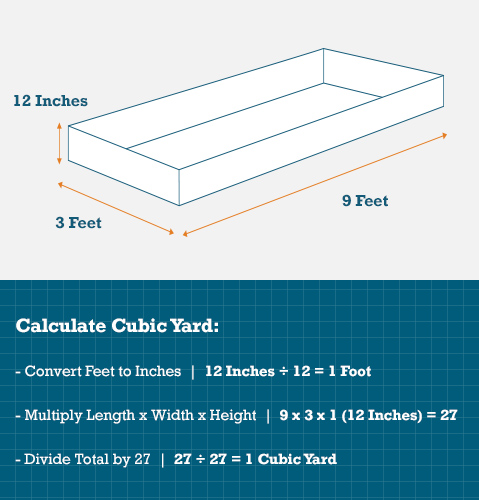
Image Source: www.budgetdumpster.com
How Many Feet In A Cubic Yard: The Math
How many feet are in a cubic yard? There are 27 cubic feet in one cubic yard. This fundamental math concept is crucial for many projects, from landscaping and construction to even decorating. When we talk about a cubic yard, we are discussing a unit of volume, not a linear measurement. Let’s dive deep into the mathematics and practical applications of the cubic yard measurement.
Fathoming the Cubic Yard Measurement
A cubic yard is a unit of volume in the imperial and United States customary systems of measurement. It is defined as the volume of a cube that measures one yard on each side. This might seem straightforward, but the “cubic” aspect is key. It means we are measuring space in three dimensions: length, width, and height.
Think of it like building with blocks. If you take a block that is one yard long, one yard wide, and one yard high, that single block represents one cubic yard. This is the core of understanding a cubic yard measurement.
Deciphering the Yard to Feet Conversion
Before we can figure out how many feet are in a cubic yard, we need to establish the basic relationship between yards and feet. This is a fundamental yard to feet conversion that underpins all subsequent calculations.
- 1 yard = 3 feet
This simple conversion is often learned in early school years and is essential for many measurements. It’s the first step in bridging the gap between these two common units of length.
The Volume of a Cubic Yard: Building the Foundation
Now, let’s apply that length conversion to volume. A cubic yard is a cube with sides of one yard each. To find the volume of any cube, you multiply the length of one side by itself three times (length x width x height).
So, for a cubic yard:
- Length = 1 yard
- Width = 1 yard
- Height = 1 yard
Volume of a cubic yard = 1 yard × 1 yard × 1 yard = 1 cubic yard
This confirms what a cubic yard represents in terms of its dimensions.
The Crucial Cubic Feet in a Yard Calculation
This is where the core question, “How many feet in a cubic yard?”, gets answered. We know that 1 yard equals 3 feet. To find the volume in cubic feet, we need to use this conversion for each dimension of our cubic yard.
- Length in feet = 1 yard = 3 feet
- Width in feet = 1 yard = 3 feet
- Height in feet = 1 yard = 3 feet
Now, we calculate the volume in cubic feet using these measurements:
- Volume in cubic feet = 3 feet × 3 feet × 3 feet
Let’s break down this volume calculation:
- 3 feet × 3 feet = 9 square feet (This is the area of one side of the cube in square feet)
- 9 square feet × 3 feet = 27 cubic feet
Therefore, there are 27 cubic feet in one cubic yard. This is the definitive feet in a cubic yard answer. This relationship is constant and is the cornerstone of many practical applications.
Illustrating the Cubic Yard to Feet Conversion
To make this visual, imagine a large cube. Each edge of this cube is exactly 3 feet long.
- Along the length, you can fit three 1-foot segments.
- Along the width, you can fit three 1-foot segments.
- Along the height, you can fit three 1-foot segments.
Now, picture filling this 3-foot cube with smaller, 1-foot cubes.
- The bottom layer will be a grid of 3 feet by 3 feet, holding 3 × 3 = 9 of the smaller cubes.
- Since the height is also 3 feet, you will have 3 such layers stacked on top of each other.
- Total small cubes = 9 cubes per layer × 3 layers = 27 cubic feet.
This practical visualization solidifies the cubic yard to feet conversion.
Converting Cubic Yards to Feet: Practical Applications
Knowing that 1 cubic yard equals 27 cubic feet is incredibly useful. This converting cubic yards to feet knowledge helps in various scenarios:
- Landscaping: When ordering mulch, soil, or gravel, it’s often sold by the cubic yard. If you need to know the equivalent in cubic feet for your wheelbarrow or truck bed, you multiply the cubic yard amount by 27.
- Construction: Concrete is a common material measured in cubic yards. Understanding the cubic feet equivalent helps in estimating the amount of material needed for foundations, patios, or walls.
- Home Improvement: Whether it’s filling a small garden bed or calculating the volume of a sandbox, this conversion is handy.
How to Calculate Cubic Yards: A Step-by-Step Guide
When you need to determine the how to calculate cubic yards for a space or material, follow these steps:
-
Measure the dimensions:
- Measure the length of the area in yards.
- Measure the width of the area in yards.
- Measure the height (or depth) of the area in yards.
-
Convert all measurements to yards: If your measurements are in feet, convert them to yards by dividing by 3. For example, 6 feet = 6 / 3 = 2 yards.
-
Multiply the dimensions:
- Length (yards) × Width (yards) × Height (yards) = Volume in cubic yards.
Example: You need to fill a rectangular garden bed that is 9 feet long, 6 feet wide, and 1 foot deep.
-
Step 1 & 2: Convert to yards:
- Length = 9 feet / 3 = 3 yards
- Width = 6 feet / 3 = 2 yards
- Height = 1 foot / 3 = 0.33 yards (approximately)
-
Step 3: Calculate in cubic yards:
- Volume = 3 yards × 2 yards × 0.33 yards = 1.98 cubic yards (approximately)
Alternative Calculation: Using Cubic Feet First
You can also calculate the volume in cubic feet first and then convert to cubic yards. This is often easier if your initial measurements are in feet.
-
Measure the dimensions in feet:
- Length (feet)
- Width (feet)
- Height (feet)
-
Multiply the dimensions in feet:
- Length (feet) × Width (feet) × Height (feet) = Volume in cubic feet.
-
Convert cubic feet to cubic yards:
- Volume in cubic feet / 27 = Volume in cubic yards.
Example (same garden bed): 9 feet long, 6 feet wide, and 1 foot deep.
-
Step 1: Measurements in feet are already given.
- Length = 9 feet
- Width = 6 feet
- Height = 1 foot
-
Step 2: Calculate in cubic feet:
- Volume = 9 feet × 6 feet × 1 foot = 54 cubic feet.
-
Step 3: Convert to cubic yards:
- Volume in cubic yards = 54 cubic feet / 27 = 2 cubic yards.
This method might be more practical for most DIYers as measurements are often taken in feet.
Cubic Yards to Linear Feet: A Different Perspective
It’s important to distinguish between volume and linear measurement. The question “How many feet in a cubic yard?” specifically refers to volume. However, sometimes people might inadvertently mix concepts or wonder about related conversions.
Cubic yards to linear feet is not a direct conversion because you are comparing a unit of volume (cubic yards) to a unit of length (linear feet). You cannot directly convert one to the other without additional context or assumptions.
However, if the question implies something like “How many linear feet of a material that is one foot wide and one foot deep would make up a cubic yard?”, then we can answer that.
We know 1 cubic yard = 27 cubic feet.
If the material has a cross-sectional area of 1 foot × 1 foot = 1 square foot, then to get a volume of 27 cubic feet, you would need a length of 27 feet.
- Volume = Area × Length
- 27 cubic feet = 1 square foot × Length
- Length = 27 cubic feet / 1 square foot = 27 linear feet
So, in this specific context, 27 linear feet of a 1ft x 1ft cross-section would equal one cubic yard. It’s crucial to remember this is a derived relationship based on a specific assumption about the cross-sectional area.
Common Scenarios and Calculations
Let’s look at some practical examples to reinforce the cubic yard to feet conversion and how to calculate cubic yards.
Scenario 1: Ordering Mulch for a Flower Bed
You have a flower bed that measures 12 feet long, 6 feet wide, and you want a depth of 3 inches of mulch.
-
Convert all measurements to feet:
- Length = 12 feet
- Width = 6 feet
- Depth = 3 inches / 12 inches/foot = 0.25 feet
-
Calculate the volume in cubic feet:
- Volume (cubic feet) = 12 ft × 6 ft × 0.25 ft = 18 cubic feet
-
Convert cubic feet to cubic yards:
- Volume (cubic yards) = 18 cubic feet / 27 cubic feet/cubic yard = 0.67 cubic yards
You would need approximately 0.67 cubic yards of mulch. It’s often wise to round up slightly when ordering materials to account for settling and uneven distribution. So, you might order 0.75 cubic yards or 1 cubic yard.
Scenario 2: Calculating Concrete for a Patio Slab
You are pouring a concrete patio slab that is 10 feet by 10 feet and 6 inches thick.
-
Convert all measurements to feet:
- Length = 10 feet
- Width = 10 feet
- Thickness = 6 inches / 12 inches/foot = 0.5 feet
-
Calculate the volume in cubic feet:
- Volume (cubic feet) = 10 ft × 10 ft × 0.5 ft = 50 cubic feet
-
Convert cubic feet to cubic yards:
- Volume (cubic yards) = 50 cubic feet / 27 cubic feet/cubic yard = 1.85 cubic yards
You will need approximately 1.85 cubic yards of concrete. Again, rounding up to 2 cubic yards would be a safe bet to ensure you have enough.
Scenario 3: Estimating Soil for a Raised Garden
You are building a raised garden bed that is 8 feet long, 4 feet wide, and 2 feet high.
-
Measurements are already in feet.
- Length = 8 feet
- Width = 4 feet
- Height = 2 feet
-
Calculate the volume in cubic feet:
- Volume (cubic feet) = 8 ft × 4 ft × 2 ft = 64 cubic feet
-
Convert cubic feet to cubic yards:
- Volume (cubic yards) = 64 cubic feet / 27 cubic feet/cubic yard = 2.37 cubic yards
You will need about 2.37 cubic yards of soil. Ordering 2.5 cubic yards would be a sensible approach.
Table of Conversions and Equivalents
Here’s a quick reference table summarizing the key conversions:
| Unit | Equivalent in Feet | Calculation |
|---|---|---|
| 1 Yard (Linear) | 3 Feet | 1 yard = 3 feet |
| 1 Square Yard | 9 Square Feet | 1 yard x 1 yard = 3 ft x 3 ft = 9 sq ft |
| 1 Cubic Yard | 27 Cubic Feet | 1 yd x 1 yd x 1 yd = 3ft x 3ft x 3ft = 27 cu ft |
This table clearly illustrates the relationship, emphasizing the feet in a cubic yard result.
Tools for Cubic Yard Measurement
While manual calculation is important for understanding the concept, various tools can assist with cubic yard measurement:
- Measuring Tapes: Essential for taking accurate linear measurements.
- Online Cubic Yard Calculators: Many websites offer free tools where you input dimensions, and they automatically perform the cubic yard to feet conversion and the how to calculate cubic yards process. These are great for quick estimates.
- Spreadsheets: For multiple calculations or complex shapes, using spreadsheet software like Microsoft Excel or Google Sheets can be very efficient. You can set up formulas for the conversion.
Common Pitfalls to Avoid
When working with cubic yards, some common mistakes can lead to over- or under-ordering materials:
- Confusing Linear Feet with Cubic Feet: Remember that cubic yards measure volume, not just length. A 3-foot long piece of lumber is 3 linear feet, not a fraction of a cubic yard.
- Incorrect Unit Conversion: Ensure all measurements are in the same unit (e.g., all feet or all yards) before multiplying.
- Ignoring Depth/Height: Forgetting to include the depth or height of the material needed is a frequent error in volume calculation. A shallow layer requires significantly less material than a deep one.
- Not Accounting for Compaction: Materials like soil and mulch tend to settle after being placed. It’s often wise to add 10-15% extra to your calculated volume.
- Rounding Errors: While some rounding is necessary, excessive rounding too early in the calculation can lead to significant inaccuracies.
Frequently Asked Questions (FAQ)
Q1: What is a cubic yard?
A1: A cubic yard is a unit of volume in the imperial and US customary systems. It represents the space occupied by a cube that measures one yard on each side.
Q2: How many linear feet are in a cubic yard?
A2: You cannot directly convert cubic yards to linear feet because they measure different things (volume vs. length). However, if you assume a cross-sectional area of 1 square foot, then 27 linear feet of that material would equal one cubic yard.
Q3: Can I convert cubic yards to cubic feet manually?
A3: Yes, you can. Since 1 yard = 3 feet, then 1 cubic yard = 1 yd x 1 yd x 1 yd = 3 ft x 3 ft x 3 ft = 27 cubic feet. For converting a larger quantity, multiply the number of cubic yards by 27 to get the equivalent in cubic feet.
Q4: Why is the cubic yard measurement important?
A4: The cubic yard measurement is essential in industries like construction, landscaping, and agriculture for accurately quantifying and ordering materials such as concrete, gravel, soil, and mulch. It ensures that the correct amount of material is purchased for a project.
Q5: If I have a space that is 3 yards by 3 yards by 1 yard, how many cubic feet is that?
A5: First, calculate the volume in cubic yards: 3 yards x 3 yards x 1 yard = 9 cubic yards. Then, convert to cubic feet: 9 cubic yards x 27 cubic feet/cubic yard = 243 cubic feet.
Q6: What is the formula for calculating cubic yards?
A6: The general formula for a rectangular prism (like a pile of material or a hole) is Length x Width x Height. If you measure in yards, the result is in cubic yards. If you measure in feet, you will get cubic feet, which you then divide by 27 to convert to cubic yards.
Conclusion
The question “How many feet in a cubic yard?” is fundamental for anyone undertaking projects that involve bulk materials. The answer, 27 cubic feet, is a simple but powerful conversion. By mastering the yard to feet conversion and applying it to volume calculations, you can confidently estimate material needs for landscaping, construction, and countless other tasks. Whether you are calculating the volume of soil for a garden or concrete for a foundation, remembering that 1 cubic yard equals 27 cubic feet will ensure accuracy and efficiency in your projects. The ability to perform converting cubic yards to feet and to calculate cubic yards accurately is a valuable skill that saves time, money, and frustration.