
A single cubic yard is equal to 27 cubic feet. This guide will help you convert between these units of volume easily.
When you’re dealing with projects that involve materials like soil, gravel, concrete, mulch, or even space planning, knowing how to convert between different units of measurement is essential. Two common units for measuring volume are cubic yards and cubic feet. You might be wondering, “How many cubic feet in 1 yard?” The answer is straightforward: 1 cubic yard equals 27 cubic feet. This fundamental conversion is key to accurate calculations for everything from landscaping to construction.
Let’s dive deeper into understanding this relationship and how it can help you in practical situations. We’ll explore the math behind it, provide easy ways to perform conversions, and offer real-world examples. Whether you’re buying materials for your garden or estimating space for a new deck, this guide will equip you with the knowledge to confidently handle cubic measurement conversion.
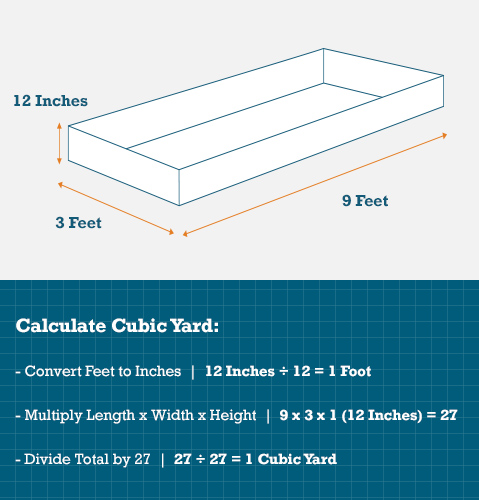
Image Source: www.budgetdumpster.com
The Basic Conversion: Yard to Cubic Feet
To grasp how many cubic feet in a yard, we first need to think about what a “yard” means in the context of volume. When we talk about cubic yards, we’re referring to a cube that measures 1 yard in length, 1 yard in width, and 1 yard in height.
Breaking Down the Dimensions
- Length: 1 yard
- Width: 1 yard
- Height: 1 yard
Converting Yards to Feet
Before we can calculate the cubic measurement, we need to ensure all dimensions are in the same unit. We know that:
- 1 yard = 3 feet
So, our 1-yard cube actually measures:
- Length: 3 feet
- Width: 3 feet
- Height: 3 feet
Calculating Cubic Feet
Now, to find the volume in cubic feet, we multiply these dimensions together:
Volume = Length × Width × Height
Volume = 3 feet × 3 feet × 3 feet
Volume = 27 cubic feet
This is why there are 27 cubic feet per cubic yard. It’s a direct result of converting each linear dimension from yards to feet before calculating the volume.
Converting Cubic Yards to Cubic Feet: The Practical Application
Knowing the basic conversion is great, but how do you use it when you need to convert cubic yards to cubic feet for a real project? It’s simpler than you might think.
The core principle is to multiply the number of cubic yards you have by 27.
The Formula
Number of Cubic Feet = Number of Cubic Yards × 27
Example Scenario 1: Ordering Mulch
Imagine you’re re-mulching your garden beds, and the garden center sells mulch by the cubic yard. You’ve calculated that you need 5 cubic yards of mulch. To figure out how much that is in cubic feet, you’d use the formula:
Cubic Feet of Mulch = 5 cubic yards × 27 cubic feet/cubic yard
Cubic Feet of Mulch = 135 cubic feet
This might be useful if you’re trying to estimate how much space 135 cubic feet of mulch will fill, perhaps for a delivery truck’s capacity or to compare with bag sizes sold in cubic feet.
Example Scenario 2: Concrete Delivery
For a small patio project, you might need 2 cubic yards of concrete. To know the total volume in cubic feet, you would calculate:
Cubic Feet of Concrete = 2 cubic yards × 27 cubic feet/cubic yard
Cubic Feet of Concrete = 54 cubic feet
This helps you visualize the volume of concrete you’ll be working with.
Converting Cubic Feet to Cubic Yards: The Reverse Calculation
Sometimes, you might have measurements in cubic feet and need to convert them to cubic yards. This is common if you’re buying smaller bags of soil or sand that are often labeled in cubic feet.
To perform this conversion, you simply reverse the process: divide the number of cubic feet by 27.
The Formula
Number of Cubic Yards = Number of Cubic Feet / 27
Example Scenario 3: Buying Soil Bags
Let’s say you’re buying bags of potting soil, and each bag contains 2 cubic feet. You need to fill a raised garden bed that requires a total of 100 cubic feet of soil. To find out how many cubic yards this is equivalent to, you’d calculate:
Cubic Yards of Soil = 100 cubic feet / 27 cubic feet/cubic yard
Cubic Yards of Soil ≈ 3.70 cubic yards
This tells you that you’ll need just under 4 cubic yards of soil, which can help when comparing prices if some suppliers offer bulk discounts by the cubic yard.
Example Scenario 4: Estimating Material Needs
You’ve measured a foundation excavation and determined it’s 300 cubic feet. To order the correct amount of fill material or to calculate waste disposal volume, you’d convert this:
Cubic Yards of Excavation = 300 cubic feet / 27 cubic feet/cubic yard
Cubic Yards of Excavation ≈ 11.11 cubic yards
This helps in budgeting for material hauling or replacement.
Simplifying Cubic Measurement Conversion
The core of converting cubic yards involves the number 27. Keeping this number handy makes the process much easier.
Quick Reference Table
Here’s a handy table for common conversions:
| Cubic Yards | Cubic Feet | Calculation (Cubic Yards × 27) |
|---|---|---|
| 1 | 27 | 1 × 27 |
| 2 | 54 | 2 × 27 |
| 3 | 81 | 3 × 27 |
| 4 | 108 | 4 × 27 |
| 5 | 135 | 5 × 27 |
| 10 | 270 | 10 × 27 |
| 20 | 540 | 20 × 27 |
Mental Math Tricks
If you need to calculate cubic feet from cubic yards quickly without a calculator:
- For 1 cubic yard: Just remember it’s 27 cubic feet.
- For 2 cubic yards: Think of 2 × 27. That’s 2 × 20 = 40, plus 2 × 7 = 14. So, 40 + 14 = 54 cubic feet.
- For 3 cubic yards: 3 × 27. That’s 3 × 20 = 60, plus 3 × 7 = 21. So, 60 + 21 = 81 cubic feet.
- For 4 cubic yards: 4 × 27. That’s 4 × 20 = 80, plus 4 × 7 = 28. So, 80 + 28 = 108 cubic feet.
- For 10 cubic yards: That’s easy! 10 × 27 = 270 cubic feet.
These simple multiplications help build an intuitive feel for yardage to cubic feet conversions.
Why This Matters: Real-World Applications
Accurate volume conversion is crucial for many practical tasks. Let’s look at some common scenarios where knowing how many cubic feet in 1 yard is essential.
Landscaping and Gardening
- Mulch: To cover a garden bed, you need to know the area and the desired depth. If you calculate you need 1.5 cubic yards of mulch, that’s 1.5 × 27 = 40.5 cubic feet. This helps you order the right amount from a supplier or know how many bags to buy.
- Topsoil: Filling raised beds or creating new garden plots often requires a significant amount of topsoil. If a raised bed needs 3 cubic yards of soil, you’re looking at 3 × 27 = 81 cubic feet.
- Gravel/Stone: For pathways or drainage, you might need gravel. Ordering 2 cubic yards of gravel means you’re getting 54 cubic feet.
Construction and Home Improvement
- Concrete: Small concrete projects, like a sidewalk slab or a few fence posts, might require calculating the volume in cubic feet and then converting it to cubic yards for ordering from a concrete supplier. For example, if you need a 4ft x 4ft x 0.33ft (4 inches) slab, that’s 5.28 cubic feet. Converting this to cubic yards: 5.28 / 27 ≈ 0.195 cubic yards. Most suppliers have minimum orders, but this calculation is precise.
- Fill Dirt: If you’re leveling an area or building a berm, you might need to calculate how much fill dirt to move or order. Excavating 500 cubic feet of soil means you have 500 / 27 ≈ 18.5 cubic yards of material.
- Sand: Used for mixing with cement or as a base layer, sand is often sold by the cubic yard. Knowing the cubic feet requirement lets you perform accurate yard to cubic feet conversions.
Space Estimation
- Storage: When considering storage units or planning how much can fit in a truck, visualizing volume in cubic feet can be more intuitive. If a storage unit is advertised as being 10ft x 10ft x 10ft, its volume is 1000 cubic feet. To convert this to cubic yards: 1000 / 27 ≈ 37 cubic yards. This helps compare larger volume measurements.
Understanding the Calculation: A Deeper Dive
Let’s revisit the fundamental cubic feet calculation. The process involves cubing the linear conversion factor.
The Math Explained
We are converting a unit of volume (cubic yard) to another unit of volume (cubic feet).
1 cubic yard = 1 yard × 1 yard × 1 yard
We know 1 yard = 3 feet. Substitute this into the equation:
1 cubic yard = (3 feet) × (3 feet) × (3 feet)
Now, multiply the numbers and the units:
1 cubic yard = (3 × 3 × 3) × (feet × feet × feet)
1 cubic yard = 27 × cubic feet
This confirms the conversion factor: 27 cubic feet per cubic yard.
Working with Fractional Cubic Yards
Projects rarely require exact whole numbers of cubic yards. You might need 1.5 cubic yards or 0.75 cubic yards.
- 1.5 cubic yards: To convert to cubic feet: 1.5 × 27 = 40.5 cubic feet.
- 0.75 cubic yards: To convert to cubic feet: 0.75 × 27 = 20.25 cubic feet. (Note: 0.75 is the same as 3/4, so (3/4) * 27 = 81/4 = 20.25).
Working with Fractional Cubic Feet
If you have a measurement in cubic feet that isn’t a clean multiple of 27, the conversion to cubic yards will result in a decimal.
- 30 cubic feet: To convert to cubic yards: 30 / 27 ≈ 1.11 cubic yards.
- 50 cubic feet: To convert to cubic yards: 50 / 27 ≈ 1.85 cubic yards.
These decimal values are perfectly normal when dealing with volume conversion.
Tips for Accurate Measurements and Calculations
To ensure your cubic feet calculation and conversions are accurate, follow these tips:
- Measure Carefully: Use a reliable measuring tape and ensure your measurements are as precise as possible.
- Use Consistent Units: Always convert all your dimensions to the same unit (either feet or yards) before calculating the volume.
- Account for Shape: For irregular areas, break them down into simpler shapes (rectangles, triangles) to calculate their volumes individually and then sum them up.
- Consider Compaction/Expansion: Some materials, like soil or gravel, can compact when used or expand when excavated. Factor this in if precise volumes are critical. For instance, excavated soil often appears to be more voluminous than it will be once it settles.
- Double-Check Your Math: Especially when dealing with larger numbers, a quick double-check of your multiplication or division can prevent costly errors.
- Use Online Calculators: For complex calculations or when you want to be absolutely sure, many websites offer free cubic yardage calculators. You input your dimensions, and they handle the conversion.
Frequently Asked Questions (FAQ)
Q1: What is the simplest way to remember how many cubic feet are in a cubic yard?
A: The easiest way is to remember that 1 yard equals 3 feet. So, a cubic yard is 3 feet x 3 feet x 3 feet, which equals 27 cubic feet. Just remember the number 27!
Q2: Can I just multiply the square footage by a depth in feet to get cubic feet?
A: Yes, if you have the area in square feet and the depth in feet, you can multiply them to get the volume in cubic feet. For example, an area of 100 square feet that needs 0.5 feet of depth would be 100 sq ft * 0.5 ft = 50 cubic feet.
Q3: What if my dimensions are in inches? How do I convert that to cubic feet?
A: First, convert all your dimensions from inches to feet by dividing by 12. For example, 6 inches is 0.5 feet. Then, multiply the three dimensions in feet to get cubic feet. If you have a volume in cubic inches, divide by 1728 (since 12 inches x 12 inches x 12 inches = 1728 cubic inches) to get cubic feet.
Q4: I need 3 cubic yards of gravel. How many bags of gravel should I buy if each bag is 1 cubic foot?
A: Since 1 cubic yard is 27 cubic feet, you need 3 cubic yards * 27 cubic feet/cubic yard = 81 cubic feet of gravel. If each bag is 1 cubic foot, you will need 81 bags.
Q5: How do I calculate cubic yards for a circular area, like a tree ring?
A: For a circular area, you’ll need the radius of the circle. The area of a circle is π * radius². Convert the radius to feet if it’s in inches. Calculate the area in square feet. Then, multiply the area by the desired depth in feet to get the volume in cubic feet. Finally, divide by 27 to get cubic yards. For example, a ring with a radius of 3 feet and a depth of 0.25 feet (3 inches): Area = π * (3 ft)² = 9π sq ft ≈ 28.27 sq ft. Volume = 28.27 sq ft * 0.25 ft ≈ 7.07 cubic feet. Converting to cubic yards: 7.07 cubic feet / 27 ≈ 0.26 cubic yards.
Conclusion
Mastering the conversion between cubic yards and cubic feet is a fundamental skill for anyone undertaking projects involving material calculations, space planning, or estimations. The simple fact that 1 cubic yard equals 27 cubic feet is the key. By applying this conversion factor, whether you’re multiplying to go from yards to feet or dividing to go from feet to yards, you can confidently manage your project requirements. This detailed guide provides the explanations and practical examples needed to tackle any cubic measurement conversion with ease, ensuring accuracy and efficiency in your endeavors. Remember the core relationship, and you’ll find calculating cubic feet and understanding yardage to cubic feet becomes second nature.