
A cubic yard is a unit of volume used in the United States and the United Kingdom. A cubic yard is a cube that measures 3 feet long, 3 feet wide, and 3 feet high. This might sound simple, but its practical applications are vast, especially when dealing with materials like soil, mulch, concrete, and gravel.
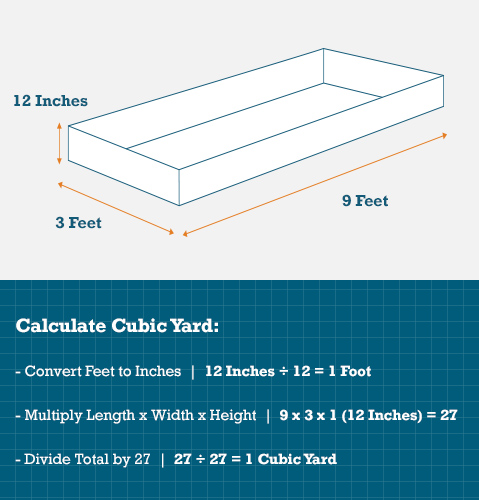
Image Source: www.budgetdumpster.com
What is a Cubic Yard?
At its core, a cubic yard represents a specific amount of space. Imagine a cube. For it to be a cubic yard, each of its sides – its length, width, and height – must be exactly three feet. When you multiply these dimensions together (3 feet x 3 feet x 3 feet), you get the total volume: 27 cubic feet. This fundamental relationship is key to many calculations.
Deciphering Cubic Yard Dimensions
The cubic yard dimensions are straightforward: 3 feet by 3 feet by 3 feet. This creates a cube with equal sides. It’s crucial to visualize this cube to grasp the volume of a cubic yard. Think of it as a box that’s three feet on every edge. This consistent measurement makes it a reliable unit for various projects, from landscaping to construction.
The Practicality of Cubic Yard Conversions
Knowing how to convert between different units is essential. The most common conversion is from cubic yards to cubic feet. Since 1 cubic yard equals 27 cubic feet, this conversion is a simple multiplication. For instance, if you need 2 cubic yards of gravel, you’ll need 54 cubic feet (2 x 27).
Cubic Yard to Cubic Feet Conversion
- 1 Cubic Yard = 27 Cubic Feet
This conversion is vital when ordering materials that might be measured or calculated in different units. Many suppliers will quote prices per cubic yard, but your project might require calculations in cubic feet, or vice versa.
Cubic Yard to Cubic Meters Conversion
While the US primarily uses cubic yards, the rest of the world often uses the metric system, specifically cubic meters. The cubic yard conversion to cubic meters is also important for international projects or when sourcing materials from metric-heavy regions.
- 1 Cubic Yard ≈ 0.764555 Cubic Meters
This means a cubic yard is smaller than a cubic meter. If you need to order material in the US for a project that uses metric measurements, you’ll need to factor in this conversion.
How to Measure a Cubic Yard
Measuring for a cubic yard depends on the shape of the space or material you need to quantify.
For Rectangular or Square Areas (e.g., Garden Beds, Patios):
- Measure the Length: Measure the longest side of your area in feet.
- Measure the Width: Measure the shorter side of your area in feet.
- Measure the Depth (Height): Determine how deep you need the material to be, also in feet.
- Calculate Volume in Cubic Feet: Multiply Length x Width x Depth.
- Convert to Cubic Yards: Divide the total cubic feet by 27.
Formula: Volume (cubic yards) = (Length in feet × Width in feet × Depth in feet) / 27
Example: You want to fill a flower bed that is 10 feet long, 5 feet wide, and 0.5 feet deep with mulch.
* Cubic Feet = 10 ft × 5 ft × 0.5 ft = 25 cubic feet
* Cubic Yards = 25 cubic feet / 27 = approximately 0.93 cubic yards. You would likely round up to 1 cubic yard to be safe.
For Uneven or Irregular Shapes:
This is where it gets trickier. You might need to break the area into smaller, more manageable shapes (like rectangles or triangles) and calculate each section separately, then add them together. Alternatively, for large, complex areas, professional measurement might be necessary.
Estimating with a Cubic Yard Calculator
To simplify these calculations, a cubic yard calculator is an invaluable tool. You can find many online that allow you to input your dimensions (often in feet or inches) and instantly get the result in cubic yards. These calculators are especially helpful for quickly checking estimates for various landscaping or construction materials.
Common Uses of Cubic Yards
The cubic yard material concept is fundamental in many industries and personal projects.
Landscaping Materials
- Topsoil: Used to establish new lawns, fill raised beds, or amend existing soil. A common depth for topsoil is 4-6 inches.
- Mulch: Helps retain moisture, suppress weeds, and improve soil health. Typically applied at a depth of 2-4 inches.
- Gravel and Stone: Used for pathways, driveways, drainage, and decorative purposes. The required depth varies significantly based on the application.
- Compost: Enhances soil fertility and structure. Often mixed into existing soil or used as a top dressing.
Construction Materials
- Concrete: One of the most common uses. Concrete is often ordered and mixed in cubic yard quantities.
- Sand and Gravel (Aggregate): Essential components in concrete mixes, as well as for road base and foundations.
- Fill Dirt: Used to level out uneven ground or build up areas.
Quantifying Volume in Different Scenarios
Let’s delve deeper into specific scenarios where what is a cubic yard becomes a practical question.
Landscaping a Backyard
Imagine you’re revamping your backyard. You plan to:
- Create a new flower bed 12 feet long, 4 feet wide, and 6 inches (0.5 feet) deep.
- Lay a gravel pathway 20 feet long, 3 feet wide, and 4 inches (0.33 feet) deep.
- Add a 3-inch (0.25 feet) layer of mulch to existing beds totaling 100 square feet.
Let’s calculate the cubic yards needed for each:
-
Flower Bed (Topsoil):
- Volume = 12 ft × 4 ft × 0.5 ft = 24 cubic feet
- Cubic Yards = 24 / 27 ≈ 0.89 cubic yards. Order 1 cubic yard.
-
Gravel Pathway:
- Volume = 20 ft × 3 ft × 0.33 ft = 19.8 cubic feet
- Cubic Yards = 19.8 / 27 ≈ 0.73 cubic yards. Order 1 cubic yard.
-
Mulch:
- Volume = 100 sq ft × 0.25 ft = 25 cubic feet
- Cubic Yards = 25 / 27 ≈ 0.93 cubic yards. Order 1 cubic yard.
In this scenario, you’d need approximately 3 cubic yards of material in total. Always add a little extra (5-10%) for settling, compaction, and potential spills.
Building a Small Concrete Patio
Suppose you want to pour a small concrete patio that is 8 feet by 10 feet and 6 inches (0.5 feet) thick.
- Calculate Volume in Cubic Feet: 8 ft × 10 ft × 0.5 ft = 40 cubic feet
- Convert to Cubic Yards: 40 cubic feet / 27 ≈ 1.48 cubic yards.
For concrete, it’s crucial to order a bit more due to waste and potential unevenness in the sub-base. It would be wise to order 1.5 to 1.75 cubic yards of concrete.
Comprehending the Weight of a Cubic Yard
Knowing the volume is one thing, but how much does a cubic yard weigh? This varies significantly depending on the material’s density.
Here are some approximate weights for common materials per cubic yard:
| Material | Approximate Weight (pounds) | Approximate Weight (kilograms) |
|---|---|---|
| Topsoil (dry) | 2000 – 2700 | 907 – 1225 |
| Topsoil (wet) | 2500 – 3500 | 1134 – 1588 |
| Gravel (compacted) | 2400 – 3000 | 1089 – 1361 |
| Sand (dry) | 2500 – 3000 | 1134 – 1361 |
| Mulch (wood chips) | 400 – 600 | 181 – 272 |
| Compost | 800 – 1600 | 363 – 726 |
| Concrete (wet) | 3800 – 4050 | 1724 – 1837 |
Important Considerations for Weight:
- Moisture Content: Wet materials are significantly heavier than dry materials.
- Compaction: How tightly packed the material is affects its density and therefore its weight.
- Material Composition: The exact type of rock, soil, or organic matter will influence its specific gravity.
When ordering heavy materials like gravel or concrete, knowing the approximate weight can be important for site preparation, delivery logistics, and ensuring your sub-base can handle the load. For example, if you’re filling a large hole with gravel, you need to ensure the surrounding earth can support the weight.
When to Order More Than You Calculate
It’s a common piece of advice in landscaping and construction: “When in doubt, order a little extra.” Why?
- Settling and Compaction: Most bulk materials will settle and compact over time, especially after rain or heavy use. Your initial fluffy pile will become denser.
- Uneven Sub-base: The ground you’re filling might not be perfectly level, meaning you’ll need more material to achieve the desired depth in some areas.
- Spillage and Waste: Some material is inevitably lost during loading, transport, and spreading.
- Accuracy of Measurements: It’s hard to be perfectly precise, especially with irregular shapes or when measuring on-site.
A general rule of thumb is to add 5-10% to your calculated amount. A cubic yard calculator can help with the initial calculation, but always factor in these practicalities.
Can I Buy Less Than a Cubic Yard?
Yes, most suppliers will sell materials in fractions of a cubic yard (e.g., half a cubic yard, quarter of a cubic yard) or even by the bag. Bagged materials are convenient for smaller projects, but buying in bulk (by the cubic yard) is usually more cost-effective for larger jobs.
Who Delivers Cubic Yards?
Bulk materials like soil, mulch, sand, gravel, and concrete are typically delivered by landscaping supply companies, garden centers, lumber yards, and specialized concrete suppliers. They usually use large trucks capable of hauling several cubic yards at a time. Confirm delivery options and any associated fees when ordering.
Fathoming the Applications: A Deeper Look
Let’s explore some specific applications and how cubic yards play a role.
Driveway Construction
A typical residential driveway might require a base layer of compacted gravel and then a layer of asphalt or concrete.
-
Gravel Base: For a driveway 50 feet long and 10 feet wide, with a compacted base of 4 inches (0.33 feet) deep:
- Volume = 50 ft × 10 ft × 0.33 ft = 165 cubic feet
- Cubic Yards = 165 / 27 ≈ 6.1 cubic yards. Order about 6.5 – 7 cubic yards.
-
Concrete Driveway: If pouring a concrete driveway of the same dimensions and a thickness of 4 inches (0.33 feet):
- Volume = 165 cubic feet
- Cubic Yards = 165 / 27 ≈ 6.1 cubic yards. Order about 6.5 – 7 cubic yards of concrete.
Raised Garden Beds
Raised beds are popular for their ease of access and improved drainage.
- Example: A raised bed measuring 8 feet long, 4 feet wide, and 1 foot deep.
- Volume = 8 ft × 4 ft × 1 ft = 32 cubic feet
- Cubic Yards = 32 / 27 ≈ 1.18 cubic yards. Order 1.25 to 1.5 cubic yards of soil mix.
Decorative Stone or Rock
Landscaping with decorative stones requires calculating the volume needed for coverage.
- Scenario: You want to cover a garden area that is 20 feet by 30 feet with decorative stone to a depth of 3 inches (0.25 feet).
- Volume = 20 ft × 30 ft × 0.25 ft = 150 cubic feet
- Cubic Yards = 150 / 27 ≈ 5.56 cubic yards. Order about 6 cubic yards.
Estimating Material Needs Accurately
Accurate estimation is key to avoiding unnecessary costs and project delays. A cubic yard calculator is your best friend here, but always double-check your measurements and remember the factors for extra material.
Converting Units for International Projects
If you’re working on a project where materials are sourced internationally, or if you’re involved with an overseas client, mastering cubic yard conversion is essential. For example, if a European supplier quotes you 10 cubic meters of gravel, you’ll need to convert this to cubic yards for your US-based budgeting:
- 10 cubic meters × (1 cubic yard / 0.764555 cubic meters) ≈ 13.08 cubic yards.
Frequently Asked Questions (FAQ)
Q1: What is the standard size of a cubic yard?
A1: A cubic yard is a cube with sides measuring 3 feet in length, 3 feet in width, and 3 feet in height.
Q2: How many cubic feet are in a cubic yard?
A2: There are exactly 27 cubic feet in 1 cubic yard (3 ft x 3 ft x 3 ft = 27 cu ft).
Q3: Can I pick up a cubic yard of material myself?
A3: Yes, if you have a truck or trailer capable of hauling the weight and volume. Remember that a cubic yard of dense material like gravel can weigh over 2,500 pounds, so ensure your vehicle has sufficient payload capacity.
Q4: How do I calculate the amount of mulch I need for my garden?
A4: Measure the length and width of your garden area in feet. Decide on the desired depth in feet (e.g., 3 inches = 0.25 feet). Multiply Length × Width × Depth to get cubic feet, then divide by 27 to get cubic yards.
Q5: Why is it important to add extra material when ordering?
A5: Extra material is recommended to account for settling, compaction, uneven ground, and potential spillage during handling.
Q6: How does moisture affect the weight of a cubic yard?
A6: Wet materials are considerably heavier than dry materials because water adds significant mass. This is particularly true for soils and aggregates.
By grasping the dimensions, mastering conversions, and considering practical application, you can confidently order and use materials measured in cubic yards for any project.