
A common question for homeowners and gardeners alike is, “How many square feet in a yard?” The answer is straightforward: There are 9 square feet in 1 square yard. This guide will help you master yard to square feet conversion and accurately measure your outdoor spaces.
Whether you’re planning a new garden bed, buying sod, or just curious about your property’s size, knowing how to convert yard measurements to square feet is essential. We’ll cover everything from basic calculations to practical applications, ensuring you can confidently measure your yard area in square feet. Let’s dive into deciphering yard dimensions and transforming them into easily understandable square footage.
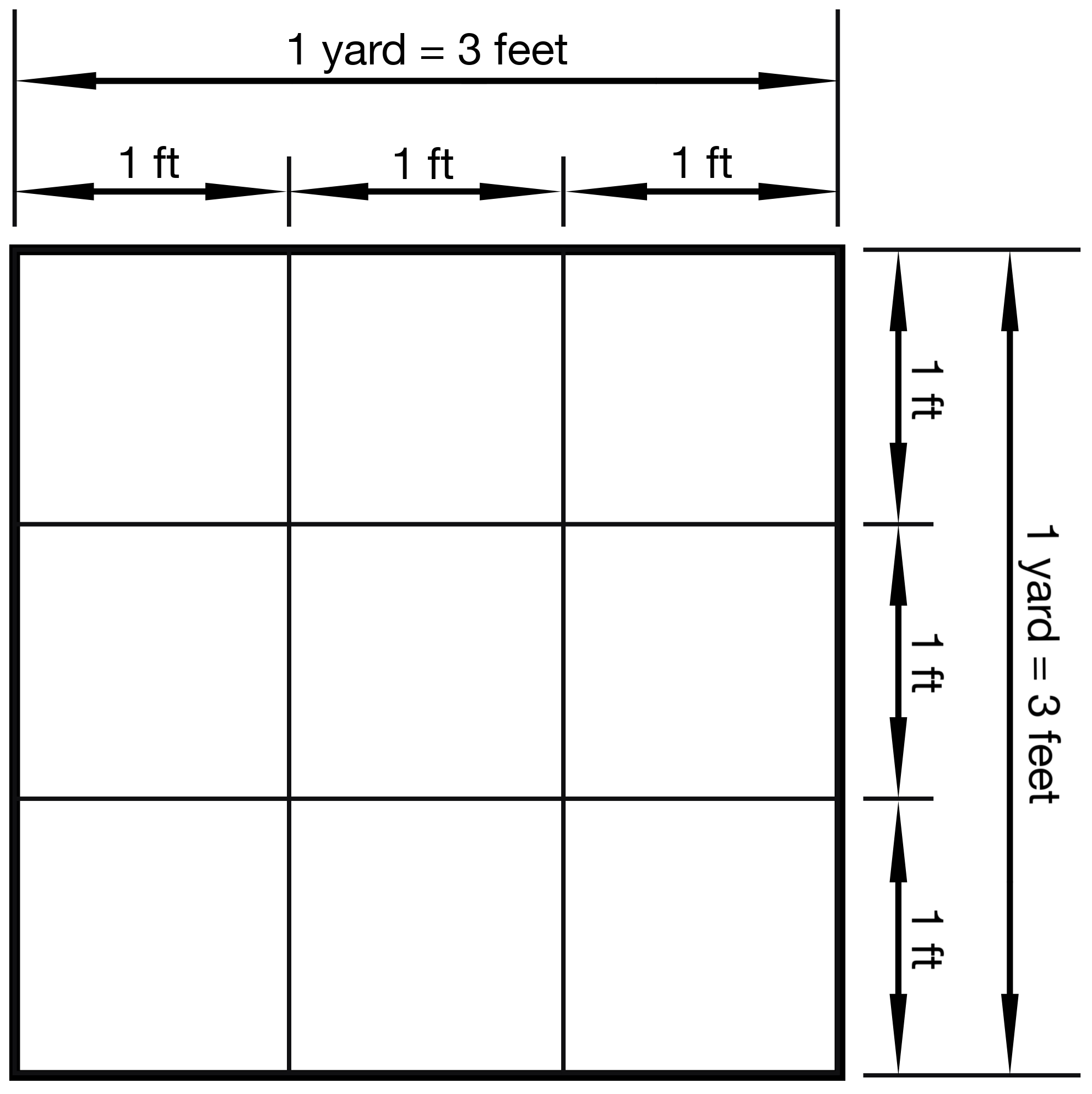
Image Source: www.inchcalculator.com
The Basic Conversion: Yards to Feet
At its core, the relationship between yards and feet is simple:
- 1 yard = 3 feet
This linear measurement is the foundation for understanding area. When we talk about the square footage of a yard, we’re talking about a two-dimensional space – length multiplied by width.
So, if we want to find out how many square feet are in a square yard, we square the linear conversion:
- 1 square yard = 1 yard × 1 yard
- 1 square yard = 3 feet × 3 feet
- 1 square yard = 9 square feet
This fundamental fact is the key to all subsequent yard to square feet conversion calculations. Keep this number, 9, in mind – it’s your magic number for turning yards into feet when measuring area.
Why Measure Your Yard in Square Feet?
You might wonder why you’d need to convert yards to square feet. Several practical reasons make this conversion useful:
- Landscaping and Gardening: When buying soil, mulch, fertilizer, or grass seed, quantities are often listed in square feet. Knowing your square feet in a garden or lawn allows you to purchase the right amount.
- Fencing and Paving: If you’re installing a fence or patio, material costs are typically calculated based on the total square footage.
- Real Estate: Property listings and appraisals often use square feet to describe lot sizes and house footprints.
- Construction Projects: Building decks, sheds, or other outdoor structures requires accurate area measurements.
- Planning and Design: Visualizing the area of a yard in square feet helps in planning the layout of gardens, play areas, or seating zones.
How to Calculate Yardage to Square Feet
Converting measurements from yards to square feet depends on whether you’re dealing with linear measurements or area measurements.
Linear Measurement Conversion
If you have a measurement in linear yards and need it in linear feet, the conversion is simple: multiply the number of yards by 3.
- Example: If you have a fence that is 10 yards long, it is 10 yards × 3 feet/yard = 30 feet long.
Area Measurement Conversion
This is where the 9 square feet per square yard comes into play. If you have an area measured in square yards and need it in square feet, multiply the number of square yards by 9.
- Example: If your garden plot is 5 square yards, its area in square feet is 5 square yards × 9 square feet/square yard = 45 square feet.
Converting Yard Dimensions to Square Feet
Often, you’ll have the dimensions of your yard in yards and need to find the total area in square feet. Here’s how to approach this:
- Measure your yard’s dimensions in yards. Measure the length and width of the area you’re interested in.
- Calculate the area in square yards. Multiply the length (in yards) by the width (in yards).
- Convert square yards to square feet. Multiply the result from step 2 by 9.
Let’s break this down with a common scenario: a rectangular yard.
Calculating the Area of a Rectangular Yard
The formula for the area of a rectangle is:
- Area = Length × Width
If your yard’s length is 20 yards and its width is 15 yards:
- Area in square yards = 20 yards × 15 yards = 300 square yards
Now, to find the square footage of a yard, we convert this to square feet:
- Area in square feet = 300 square yards × 9 square feet/square yard = 2700 square feet
So, a yard that measures 20 yards by 15 yards has an area of 2700 square feet.
What If My Yard Isn’t a Perfect Rectangle?
Many yards have irregular shapes. To measure these, you can break them down into simpler shapes like rectangles, squares, and triangles.
For Irregular Shapes:
- Sketch your yard: Draw a rough outline of your yard.
- Divide into sections: Mentally (or on paper) divide the yard into smaller, manageable shapes (rectangles, squares, triangles).
- Measure each section: Measure the length and width (and height for triangles) of each section in yards.
- Calculate the area of each section in square yards: Use the appropriate area formula for each shape.
- Rectangle/Square: Length × Width
- Triangle: ½ × Base × Height
- Sum the areas: Add up the square yardage of all the sections to get the total area in square yards.
- Convert to square feet: Multiply the total square yardage by 9.
This process allows you to accurately calculate yardage to square feet even for complex layouts.
Practical Examples of Converting Yard Measurements
Let’s walk through a few more practical examples to solidify your grasp on converting yard measurements to square feet.
Example 1: Buying Sod for a Square Lawn
Suppose you want to re-sod a perfectly square lawn that measures 12 yards by 12 yards.
- Area in square yards: 12 yards × 12 yards = 144 square yards.
- Area in square feet: 144 square yards × 9 square feet/square yard = 1296 square feet.
You’ll need 1296 square feet of sod.
Example 2: Planting a Garden Bed
You’re planning a new flower bed that will be 4 yards long and 2 yards wide.
- Area in square yards: 4 yards × 2 yards = 8 square yards.
- Area in square feet: 8 square yards × 9 square feet/square yard = 72 square feet.
This gives you the square feet in a garden bed area.
Example 3: Calculating Material for a Circular Patio
Circular areas require a slightly different formula for area calculation, but the final conversion is the same. Let’s say you want to build a circular patio with a diameter of 10 yards.
- Radius: The radius is half the diameter, so 10 yards / 2 = 5 yards.
- Area of a circle: π × radius² (where π is approximately 3.14159)
- Area in square yards: 3.14159 × (5 yards)² = 3.14159 × 25 square yards ≈ 78.54 square yards.
- Area in square feet: 78.54 square yards × 9 square feet/square yard ≈ 706.86 square feet.
So, a circular patio with a 10-yard diameter covers about 706.86 square feet.
Measuring Yard Area in Square Feet: Tools and Techniques
Accurate measuring yard area in square feet starts with good tools and consistent techniques.
Tools for Measuring
- Measuring Tape: A long, durable measuring tape (at least 50-100 feet or 20-30 meters) is essential. Steel tapes are generally more accurate and last longer than fabric ones.
- Laser Distance Measurer: For larger areas or when you need to measure distances that are difficult to reach, a laser measurer can be very helpful. These tools provide instant digital readouts.
- Marking Stakes or Flags: To mark corners or points of measurement, especially in larger yards.
- Notebook and Pen/Pencil: To record your measurements carefully.
- Calculator: For performing the calculations.
Techniques for Measuring
- Start at a Corner: Begin at one corner of your property or the area you wish to measure.
- Measure Length: Extend your tape measure in a straight line along one edge to get the length. For longer distances, take multiple measurements, noting where each one ends, and add them together. Ensure the tape is taut and not sagging.
- Measure Width: From the starting corner, extend your tape measure at a 90-degree angle to the length measurement to find the width. Again, maintain a straight, taut line.
- Record Measurements: Write down your length and width measurements in yards.
- Handle Uneven Terrain: If your yard has slopes, measure along the surface. For precise area calculations, especially for paving or construction, you might need to consider surveying methods that account for elevation changes, but for most gardening purposes, surface measurement is sufficient.
- Consistency is Key: Ensure you are measuring from the same points and in the same units (yards) throughout your process before converting.
Converting Feet to Yards and Square Feet
It’s also useful to know how to go the other way – converting feet to yards.
Linear Feet to Yards
To convert feet to yards, divide the number of feet by 3.
- Example: If a fence is 60 feet long, it is 60 feet / 3 feet/yard = 20 yards long.
Square Feet to Square Yards
To convert square feet to square yards, divide the number of square feet by 9.
- Example: If you have 180 square feet of garden space, it is 180 square feet / 9 square feet/square yard = 20 square yards.
This is how you perform a yard to square feet conversion in reverse.
Tables for Quick Reference
To make converting yard measurements to square feet even easier, here are some quick reference tables.
Table 1: Linear Conversion (Yards to Feet)
| Yards | Feet |
|---|---|
| 1 | 3 |
| 2 | 6 |
| 3 | 9 |
| 4 | 12 |
| 5 | 15 |
| 6 | 18 |
| 7 | 21 |
| 8 | 24 |
| 9 | 27 |
| 10 | 30 |
Table 2: Area Conversion (Square Yards to Square Feet)
| Square Yards | Square Feet |
|---|---|
| 1 | 9 |
| 2 | 18 |
| 3 | 27 |
| 4 | 36 |
| 5 | 45 |
| 10 | 90 |
| 20 | 180 |
| 30 | 270 |
| 40 | 360 |
| 50 | 450 |
| 100 | 900 |
These tables should help you quickly find the square feet per yard conversion and vice versa.
Common Pitfalls to Avoid
When measuring yard area in square feet, people sometimes make simple mistakes:
- Not measuring in straight lines: Curved measuring tapes lead to inaccurate lengths.
- Using different units: Mixing yards and feet within the same measurement calculation without converting first.
- Forgetting to square the conversion: Only multiplying by 3 instead of 9 when converting area.
- Ignoring obstacles: Not accounting for sheds, patios, or existing structures that reduce the usable yard space.
- Inaccurate shape breakdown: When dealing with irregular shapes, miscalculating the area of individual sections.
Always double-check your measurements and calculations to ensure the most accurate yard to square feet conversion.
How to Convert Yards to Square Feet: A Step-by-Step Recap
To reiterate the core process of how to convert yards to square feet for area:
- Determine the dimensions: Measure the length and width of your area in yards.
- Calculate area in square yards: Multiply length by width (Area = L × W).
- Apply the conversion factor: Multiply the area in square yards by 9.
- Total Square Feet = Area in Square Yards × 9
This method ensures you accurately calculate the area of a yard in square feet.
Real-World Applications: More Than Just Gardening
The ability to calculate yardage to square feet extends beyond just planting.
- Home Improvement: If you’re planning to install new flooring in a covered porch or a patio area, you’ll need the square footage.
- Pool Installation: The space required for a swimming pool is always measured in square feet.
- Outdoor Lighting: When planning landscape lighting, understanding the total area of your yard can help you determine the number of lights needed.
- Play Area Design: Creating a safe play space for children requires knowing the dimensions and total square footage available.
Frequently Asked Questions (FAQ)
Q1: How many square feet are in one yard?
A1: There are 9 square feet in 1 square yard.
Q2: If my yard is 30 feet by 40 feet, how many square yards is that?
A2: First, find the area in square feet: 30 ft × 40 ft = 1200 sq ft. Then, convert to square yards: 1200 sq ft / 9 sq ft/sq yd = 133.33 sq yd.
Q3: I have a garden that is 5 yards by 3 yards. How much soil should I buy if it’s sold in bags that cover 10 square feet?
A3: Calculate the area in square feet: (5 yd × 3 yd) × 9 sq ft/sq yd = 15 sq yd × 9 sq ft/sq yd = 135 sq ft. Then, divide by the coverage per bag: 135 sq ft / 10 sq ft/bag = 13.5 bags. You’d need to buy 14 bags.
Q4: Can I use a laser measure to get my yard dimensions in feet and then convert?
A4: Yes, absolutely! Measuring in feet is very common. If you measure your yard’s length and width in feet, calculate the area in square feet, and then divide by 9 to get square yards, or simply use the square footage directly if that’s how materials are sold.
Q5: How do I measure a sloped yard for accurate square footage?
A5: For most gardening and general landscaping purposes, measure the dimensions along the surface of the slope. If precise land surveying is needed for construction or large-scale projects, consult a professional surveyor.
Q6: What are the key steps in converting yard dimensions to square feet?
A6: Measure dimensions in yards, calculate the area in square yards (Length × Width), and then multiply the result by 9 to get the area in square feet.
By mastering the simple conversion of 1 square yard = 9 square feet, you can confidently tackle any project that requires measuring your outdoor space. Whether you’re planning a small garden patch or a complete landscape overhaul, this guide provides the knowledge to accurately determine the square footage of a yard and make informed decisions.