
A mile contains 1,760 yards. This guide will help you explore the relationship between miles and yards, covering everything from basic conversions to real-world applications.
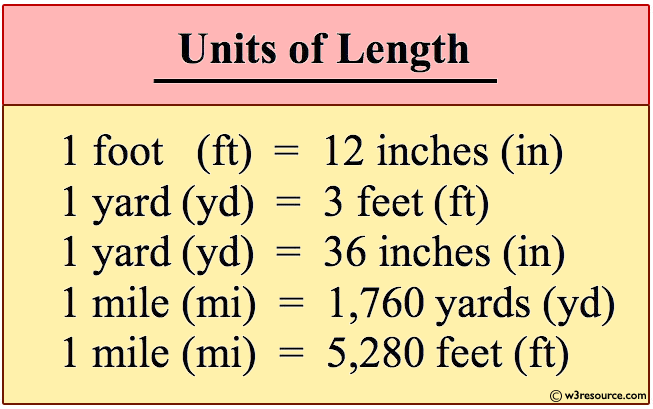
Image Source: www.w3resource.com
Deciphering the Mile: Yards, Feet, and More
When we talk about distance, especially in the imperial system, the mile is a familiar unit. But how does it break down into smaller measurements? The answer lies in a series of established conversions. We use these units every day, whether we’re discussing road distance, the length of a running track, or simply how far we’ve walked.
The Building Blocks: Yards and Feet
To grasp the “how many yards in a mile” question, we first need to look at the units that make up a mile.
The Yard: A Common Measure
The yard is a fundamental unit of length in the imperial and US customary systems. It’s a comfortable size for many everyday measurements. Think about a yardstick – its length is one yard. This is a practical tool for sewing, construction, and even measuring the dimensions of a room.
The Feet: The Smaller Companion
The foot is another common unit. You’ve likely encountered it when discussing height, the length of furniture, or the depth of a swimming pool. The relationship between a yard and a foot is straightforward:
- 1 Yard = 3 Feet
This simple conversion is key to understanding larger measurements.
The Mile: A Grander Scale
The mile is a much larger unit, primarily used for measuring longer distances. It’s how we gauge the length of journeys, the distance between cities, and the layout of roads.
The Core Conversion: Miles to Yards
So, how many yards are in a mile? The direct answer is:
There are 1,760 yards in 1 mile.
This is a foundational piece of information for anyone dealing with imperial units conversion. It’s a number you’ll often see in contexts like:
- Track Length: Standard outdoor running tracks are often measured in yards or meters.
- Road Distance: Road signs and maps use miles to indicate how far apart places are.
Fathoming the Conversion: Why 1,760?
The number 1,760 yards in a mile isn’t arbitrary. It stems from the historical development and standardization of the imperial system. Let’s break down how this conversion is derived:
- Start with the mile and its relationship to the furlong: Historically, a mile was defined as 8 furlongs.
- The furlong’s connection to yards: A furlong, which comes from the length of a furrow a plough could cut, is equal to 220 yards.
- Putting it together: If 1 mile = 8 furlongs, and 1 furlong = 220 yards, then:
1 mile = 8 furlongs * 220 yards/furlong = 1,760 yards.
This historical context helps explain the numbers we use today.
The Yardstick Length: A Practical Example
The familiar yardstick, typically 3 feet long, is exactly one-third of a furlong. If you were to lay 1,760 yardsticks end-to-end, you would have the length of one mile. This visual can make the conversion more tangible.
Connecting the Dots: Other Imperial Unit Conversions
The “how many yards in a mile” conversion is part of a larger system of imperial units conversion. Understanding these relationships helps with various distance conversion tasks.
Feet in a Mile: The Next Step
Since we know 1 yard = 3 feet, we can easily calculate the number of feet in a mile:
- 1 mile = 1,760 yards
- 1 mile = 1,760 yards * 3 feet/yard
- 1 mile = 5,280 feet
This is another commonly known conversion. So, when you see a sign saying a town is 10 miles away, you can also think of it as 52,800 feet away!
Table of Common Imperial Length Conversions
Here’s a quick reference table for some key imperial length conversions:
| Unit | Equivalent in Yards | Equivalent in Feet | Equivalent in Miles |
|---|---|---|---|
| 1 Yard | 1 | 3 | 1/1760 |
| 1 Foot | 1/3 | 1 | 1/5280 |
| 1 Mile | 1760 | 5280 | 1 |
| 1 Furlong | 220 | 660 | 1/8 |
Comprehending Distance Conversion
Converting between these units is essential for many practical applications.
Converting Miles to Yards
To perform a miles to yards conversion, you simply multiply the number of miles by 1,760.
- Formula: Yards = Miles * 1760
Example: If you need to know how many yards are in 5 miles:
5 miles * 1760 yards/mile = 8,800 yards.
Converting Yards to Miles
To convert yards to miles, you divide the number of yards by 1,760.
- Formula: Miles = Yards / 1760
Example: If a road project is 3,520 yards long:
3,520 yards / 1760 yards/mile = 2 miles.
Why Do We Use These Specific Numbers? A Historical Perspective
The imperial system’s units have evolved over centuries, with many rooted in practical, often agricultural, measures.
- The Yard: Its origin is often attributed to the length of a man’s stride or the span of his arm. It was standardized during the reign of King Henry I of England, who decreed that the yard should be the distance from the tip of his nose to the end of his thumb.
- The Furlong: As mentioned, this was the length of a furrow in a field, approximately 40 rods. A rod is 5.5 yards. So, 40 rods * 5.5 yards/rod = 220 yards.
- The Mile: The word “mile” comes from the Latin “mille passus,” meaning “a thousand paces.” A pace was generally considered two steps (left foot to left foot), making a mile roughly 2,000 paces. However, the definition evolved. King Edward I of England redefined the mile as 5,280 feet, which conveniently aligned with the 8 furlongs * 220 yards per furlong structure.
The Impact of Standardization
Without standardization, these units would be inconsistent and confusing. Think about how difficult it would be to build something or plan a journey if everyone’s “yard” or “mile” was a slightly different length. The establishment of these fixed conversion factors ensures consistency across different measurements and locations.
Real-World Applications of Miles and Yards
The question “how many yards in a mile” might seem simple, but the answer has practical implications in various aspects of life.
Road Distance and Navigation
When you see road signs, they are almost always in miles. This is crucial for:
- Travel Planning: Estimating journey times and distances.
- Navigation Apps: GPS systems rely on these measurements.
- Driving Regulations: Speed limits and distances are posted in miles.
Knowing that 1 mile is 1,760 yards allows you to convert if you’re working with measurements in yards, perhaps for a specific construction project along a road.
Track Lengths and Sports
Athletic tracks are often measured in either meters or yards.
- Outdoor Tracks: A standard outdoor athletics track is typically 400 meters, which is roughly 437.4 yards. However, some older or specific tracks might be measured in yards. For instance, a common track length in some regions was 440 yards, which is exactly a quarter of a mile. This makes races like the quarter-mile or half-mile very straightforward to measure on such a track.
- Indoor Tracks: Indoor tracks are often 200 meters, roughly 218.7 yards.
- Other Sports: Distances in sports like American football (100 yards from goal line to goal line) are also measured in yards.
Construction and Land Measurement
For smaller-scale projects, yards are more common. However, when dealing with larger plots of land or infrastructure projects, the mile might be used, requiring conversion.
- Property Lines: While often measured in feet or acres, larger rural properties might have boundaries discussed in terms of miles.
- Pipelines and Utilities: Laying pipelines or utility lines over long distances will use miles, and the contractors might need to translate this into yardage for material ordering or excavation.
The Metric to Imperial Conversion Bridge
In a world increasingly reliant on the metric system (where distances are measured in meters and kilometers), knowing imperial unit conversions is still vital. This is especially true if you’re working with historical data, American companies, or in specific industries that still adhere to imperial units.
- 1 Mile ≈ 1.609 Kilometers
- 1 Yard ≈ 0.9144 Meters
To bridge the gap from metric to imperial or vice-versa, you often have to go through these intermediate imperial units like yards or feet. For example, if you have a distance in kilometers and need to express it in yards, you’d convert kilometers to miles first, then miles to yards.
- Kilometers to Miles: Divide by 1.609
- Miles to Yards: Multiply by 1,760
Example: How many yards in 3 kilometers?
1. Convert kilometers to miles: 3 km / 1.609 km/mile ≈ 1.864 miles
2. Convert miles to yards: 1.864 miles * 1760 yards/mile ≈ 3,280.6 yards
This demonstrates the interconnectedness of different measurement systems and the importance of knowing your core conversions.
Frequently Asked Questions (FAQ)
Here are some common questions related to miles and yards:
How many yards are in a football field?
An American football field is 100 yards long between the goal lines. Including the end zones, it’s 120 yards from one end to the other.
Is a mile always 1,760 yards?
Yes, by definition in the imperial and US customary systems, 1 mile is exactly 1,760 yards.
What is a furlong?
A furlong is a unit of distance in the imperial system, equal to 220 yards or one-eighth of a mile. It was historically used in horse racing and agriculture.
Why is a mile called a mile?
The term “mile” comes from the Latin “mille passus,” meaning “a thousand paces.” The length of a pace varied, but the mile was eventually standardized.
Can I convert miles to yards easily?
Yes, it’s a straightforward multiplication. To convert miles to yards, multiply the number of miles by 1,760.
How far is a mile in simple terms?
A mile is a long distance. It’s about the length of 13 to 15 football fields laid end-to-end, or roughly the distance you can walk in 15-20 minutes.
What is a yardstick length?
A yardstick is a measuring stick that is exactly one yard long, which is equivalent to 3 feet or 36 inches.
How does metric to imperial conversion work for miles and yards?
To convert from metric to imperial, you typically use conversion factors. For example, 1 kilometer is about 0.621371 miles. Once you have miles, you multiply by 1,760 to get yards.
Conclusion: Mastering the Mile and the Yard
Knowing that there are 1,760 yards in a mile is a fundamental aspect of mastering imperial units conversion. Whether you’re calculating road distance, understanding track lengths, or simply trying to visualize distances, this knowledge is invaluable. From the practical yardstick to the vast expanse of a mile, these units connect our world in measurable ways. By grasping these basic conversions, you empower yourself to navigate and comprehend distances more effectively, bridging the gap between different measurement systems with ease.