
A yard is equivalent to 91.44 centimeters. This fundamental length conversion is key when navigating between imperial and metric units. Whether you’re a sewer, a builder, a gardener, or just curious about measurements, knowing how many cm in a yard is incredibly useful. We’ll dive deep into this conversion and explore its practical applications.
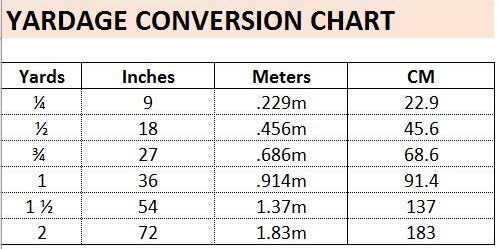
Image Source: hellosewing.com
The Building Blocks of Measurement
Before we get to the yard-to-centimeter conversion, let’s lay the groundwork by examining the basic units involved. This helps us understand the relationship between different systems of measurement and how conversions work.
Imperial Units: A Familiar Framework
The imperial system of measurement, also known as the United States customary system, is widely used in the United States, Liberia, and Myanmar. It’s a system with historical roots that relies on units like inches, feet, and yards for measuring length.
- Inch (in): The smallest common unit in the imperial system.
- Foot (ft): Consists of 12 inches.
- Yard (yd): Consists of 3 feet, or 36 inches.
- Mile (mi): Consists of 1,760 yards.
Metric Units: A Global Standard
The metric system, or the International System of Units (SI), is a decimal-based system used by most of the world. Its consistency and ease of use have made it the standard for science, industry, and international trade.
- Millimeter (mm): The smallest common unit in the metric system.
- Centimeter (cm): Consists of 10 millimeters. There are 100 centimeters in a meter.
- Meter (m): The base unit of length in the metric system.
- Kilometer (km): Consists of 1,000 meters.
The Core Conversion: Yards to Centimeters
So, how do we get from yards to centimeters? The magic happens through a series of well-established metric conversion factors.
We know that:
- 1 yard = 3 feet
- 1 foot = 12 inches
- 1 inch = 2.54 centimeters (This is the crucial conversion factor!)
Let’s put it all together:
- Yards to Feet: 1 yard * 3 feet/yard = 3 feet
- Feet to Inches: 3 feet * 12 inches/foot = 36 inches
- Inches to Centimeters: 36 inches * 2.54 cm/inch = 91.44 cm
Therefore, 1 yard = 91.44 centimeters.
This means that if you need to measure something that is 1 yard long, it will be exactly 91.44 cm in length. This is a fundamental length conversion that comes up frequently.
Why Do We Need This Conversion?
Understanding how many cm in a yard is vital for several reasons, especially when dealing with projects that require precision or when collaborating with people who use different measurement systems.
Bridging Imperial and Metric Worlds
Many industries and everyday tasks involve working with both imperial and metric units. For example, in sewing, fabric is often sold in yards, but patterns might be marked in centimeters. Similarly, construction projects might have plans with imperial measurements, but the materials themselves might be manufactured and labeled using the metric system.
- Sewing and Textiles: Fabric is typically measured in yards. If a pattern calls for 1.5 meters of fabric, you need to know how many yards that is, or vice versa. Knowing the conversion helps prevent buying too much or too little material.
- Construction and DIY: Whether you’re building a deck, hanging wallpaper, or painting a room, accurate measurements are key. If you’re using lumber measured in feet and inches, but need to cut it to a specific metric length, this conversion is indispensable.
- Gardening: Planting distances or the size of garden beds might be expressed in different units. Converting allows for precise spacing and planning.
- Travel and Geography: While countries primarily use metric units, you might encounter situations where imperial measurements are referenced in older documents or in specific contexts.
The Importance of Accuracy
In many applications, even small inaccuracies can have significant consequences. A miscalculation in a construction project could lead to materials not fitting, structural issues, or costly rework. In crafting, incorrect measurements can ruin a project entirely. Therefore, having a solid grasp of how to convert yards to centimeters ensures that your work is accurate and successful.
Practical Applications: Putting the Conversion to Work
Let’s explore some real-world scenarios where knowing how many cm in a yard is incredibly useful.
Scenario 1: The Sewing Project
Imagine you’re making a dress and the pattern calls for 2.5 yards of fabric. You go to the fabric store, and the bolt has markings in meters and centimeters. You need to ask for the correct amount.
- Calculation: 2.5 yards * 91.44 cm/yard = 228.6 cm
You would then ask for 2.286 meters or 228.6 centimeters of fabric. This demonstrates how crucial the length conversion is for everyday crafts.
Scenario 2: The Home Renovation
You’re redoing your living room and decide to install new baseboards. The total length of the walls you need to cover is 45 feet. You decide to buy baseboards that are sold in 3-meter lengths.
First, let’s convert the wall length to yards:
- Feet to Yards: 45 feet / 3 feet/yard = 15 yards
Now, let’s see how many centimeters 15 yards is:
- Yards to Centimeters: 15 yards * 91.44 cm/yard = 1371.6 cm
Each baseboard is 3 meters, which is 300 cm.
- Meters to Centimeters: 3 meters * 100 cm/meter = 300 cm
To figure out how many pieces you need:
- Total Length Needed in cm / Length per Piece in cm: 1371.6 cm / 300 cm/piece ≈ 4.57 pieces
You’ll need to buy 5 pieces of baseboard to ensure you have enough, accounting for cuts and waste. This highlights the importance of accurate feet to cm conversion and yards to meters in practical projects.
Scenario 3: The Gardener’s Plan
A gardening book suggests planting rose bushes 2 feet apart. However, you want to use centimeters for more precise spacing, especially since you have a specific area of 5 yards to plant in.
First, convert the desired spacing to centimeters:
- Feet to Inches: 2 feet * 12 inches/foot = 24 inches
- Inches to Centimeters: 24 inches * 2.54 cm/inch = 60.96 cm
So, you should plant the rose bushes approximately 61 cm apart.
Now, let’s figure out how many bushes can fit in your 5-yard planting area:
- Yards to Centimeters: 5 yards * 91.44 cm/yard = 457.2 cm
If you plant the first bush at the very beginning of the 5-yard stretch (0 cm), you can fit:
- Total Length / Spacing: 457.2 cm / 60.96 cm ≈ 7.5 spaces
This means you can plant 8 rose bushes (7 spaces plus the initial bush). This demonstrates a practical use of inches to cm and yards to cm conversions.
Intermediate Conversions: A Helpful Guide
Sometimes, you might not be directly converting yards to centimeters. You might need to convert yards to meters, or feet to centimeters, or inches to centimeters. Having these intermediate conversions handy can simplify your calculations.
Yards to Meters
While the direct conversion to centimeters is 91.44 cm per yard, we can also express this in meters. Since 1 meter = 100 centimeters:
- Yards to Centimeters: 1 yard = 91.44 cm
- Centimeters to Meters: 91.44 cm / 100 cm/meter = 0.9144 meters
So, 1 yard = 0.9144 meters. This is a common yards to meters conversion used in international contexts.
Feet to Centimeters
We already saw this in our main calculation, but it’s good to reinforce:
- 1 foot = 12 inches
- 1 inch = 2.54 cm
- Therefore, 1 foot = 12 inches * 2.54 cm/inch = 30.48 cm
This feet to cm conversion is incredibly useful for many measurements.
Inches to Centimeters
This is the fundamental conversion factor that makes everything else possible:
- 1 inch = 2.54 centimeters
This is a precise, internationally agreed-upon value.
Tools for Conversion: Making it Easy
While manual calculation is good for demonstrating the process, in practice, people often use tools to make unit conversion faster and more accurate.
Online Converters
Numerous websites offer free online length conversion tools. You simply input the value and the units, and it provides the converted measurement. These are excellent for quick checks or when dealing with complex calculations.
Mobile Apps
Many smartphone apps are designed for metric conversion and general unit conversion. These are convenient for on-the-go calculations.
Unit Conversion Charts
A unit conversion chart can be a very helpful visual aid. It lists various units and their equivalents in other systems. Keeping a handy chart can save you time, especially if you frequently work with different measurements.
Here’s a simplified unit conversion chart focusing on our core units:
| Imperial Unit | Metric Equivalent | Conversion Factor (Imperial to Metric) |
|---|---|---|
| 1 Inch | 2.54 cm | 2.54 |
| 1 Foot | 30.48 cm | 30.48 |
| 1 Yard | 91.44 cm | 91.44 |
| 1 Yard | 0.9144 m | 0.9144 |
| 1 Mile | 1609.34 m | 1609.34 |
And here are some reverse conversions, useful for converting cm to yards:
| Metric Unit | Imperial Equivalent | Conversion Factor (Metric to Imperial) |
|---|---|---|
| 1 cm | 0.3937 inches | 0.3937 |
| 1 cm | 0.0328 feet | 0.0328 |
| 1 cm | 0.0109 yards | 0.0109 |
| 1 Meter | 1.0936 yards | 1.0936 |
The Science Behind the Conversion
The relationship between the imperial and metric systems is not arbitrary. The conversion factor of 2.54 cm to an inch was formally defined in 1959. This international yard and pound agreement standardized these units for use in science and commerce worldwide.
Before this agreement, there were slight variations in the inch definition, but the 2.54 cm standard is now universally accepted. This precision ensures consistency across global industries and scientific research.
Frequently Asked Questions (FAQ)
Here are some common questions people have about converting yards to centimeters.
Q1: Is there a simple trick to remember how many cm in a yard?
While there isn’t a single “trick” that replaces the actual number, remembering that 1 inch is about 2.5 cm is a good starting point. Since a yard is 36 inches, you can then multiply 36 by 2.5 to get a rough estimate (90 cm). The precise value is 91.44 cm.
Q2: Can I convert yards directly to meters?
Yes, you can. As we saw, 1 yard is equal to 0.9144 meters. This is a very common conversion, especially in countries that predominantly use the metric system.
Q3: How do I convert centimeters to yards?
To convert centimeters to yards, you use the inverse of the yard-to-centimeter conversion. Since 1 yard = 91.44 cm, then 1 cm = 1 / 91.44 yards.
- Calculation: Divide the number of centimeters by 91.44.
- Example: To convert 182.88 cm to yards: 182.88 cm / 91.44 cm/yard = 2 yards.
Q4: Are there any situations where the conversion might vary?
In everyday use and for all standard scientific and commercial purposes, the conversion factor of 1 inch = 2.54 cm, and therefore 1 yard = 91.44 cm, is exact and does not vary. Historically, there might have been minor differences, but these are no longer relevant with international standardization.
Q5: Why is the metric system often preferred for scientific work?
The metric system is preferred in science due to its decimal nature. Units are easily divisible and scalable using powers of 10 (e.g., 10 mm = 1 cm, 100 cm = 1 m). This simplicity makes calculations much easier and reduces the chance of errors compared to the more complex fractional relationships in the imperial system (e.g., 12 inches in a foot, 3 feet in a yard). This ease of metric conversion is a significant advantage.
Q6: How do I convert feet to cm accurately?
To convert feet to cm, first convert feet to inches (multiply by 12), and then convert inches to cm (multiply by 2.54). So, 1 foot = 12 inches * 2.54 cm/inch = 30.48 cm.
Q7: What if I only know measurements in inches and need to convert them to yards?
To convert inches to yards, you need to divide the number of inches by 36 (since there are 36 inches in a yard). For example, 72 inches / 36 inches/yard = 2 yards. If you need to convert inches to centimeters first, then use the 2.54 factor.
Conclusion
Mastering the conversion of how many cm in a yard is a valuable skill. Whether you’re a hobbyist, a professional, or simply navigating daily life, having this knowledge at your fingertips ensures accuracy and efficiency. By remembering the fundamental relationship of 1 inch = 2.54 cm, you can confidently tackle any length conversion between imperial and metric units, making your projects smoother and your measurements precise. From the tailor’s shop to the construction site, understanding these metric units and how they relate to imperial units opens up a world of precise measurement.